ATLASPhilippines
about 64,000 tonnes (FAOSTAT 2024, estimated value)In-depth dossier, atlas 2026In-depth dossier: the FAOSTAT series set against other figures, the history, today's industry and its gray areas, with numbered sources. Region: Asia.
The Philippines had only one statistical landmark. This dossier completes it: the history of the sector, what it is today, and what remains uncertain, each paragraph referring to its sources, numbered at the foot of the page.
The FAOSTAT series remains displayed as is. The dossier says what it is worth, year by year when possible, and compares it with the other figures available.
- Geographic status
- country
- Name in FAOSTAT
- Philippines
- Latest value
- about 64,000 tonnes in 2024
- Nature of the value
- estimated value
- Start of the positive series
- 1961
- Series maximum
- 171,400 tonnes in 1982
Confirmed coverage: the FAOSTAT series, and a dossier of 19 sources that cross-checks the history, today’s sector and what remains uncertain.
History
Nobody knows when the coffee tree arrived in the Philippines, and the early sources contradict one another. Ukers, in 1922, gives two versions in the same book: in his chronology, Spanish missionaries introduce it from Java in 1740; in his chapter on the Pacific islands, missionaries from Mexico bring it “in the second half of the 18th century,” first in the province of La Laguna, then in those of Batangas and Cavite, south of Manila, and the coffee tree is an arabica. Walsh, in 1894, reports two other theories: Spanish priests supposedly brought it back from the Malay world, or the plant was already growing wild on Luzon without the inhabitants making use of it. The Philippine Coffee Board, the sector’s trade association, today calls a myth the story of the Franciscan monk who supposedly planted the first coffee tree at Lipa, in Batangas province, and mentions Arab traders, while displaying elsewhere on the same page the date of 1740 [2][4][11].
The 19th century is better documented. Thurber, in 1881, relates that the Economic Society of Luzon offered prizes to the largest plantations, then that the prizewinning estates were left to go to ruin, and he puts the exports of the ports of Manila, Cebu and Iloilo at 64,391 piculs in 1879 and 83,999 in 1880. The picul, a unit of weight in Asian trade, was worth 140 pounds here: 1880 therefore represents about 5,300 tonnes, of which 82% go to continental Europe. Walsh distinguishes in 1894 three commercial grades named after their port: the Luzon, a small hard bean; the Manila, produced in Laguna, Batangas and Cavite; the Zamboanga, a large bean from Mindanao with a “thin” cup. Ukers places the peak in 1883, with 16,805,000 pounds exported, or about 7,600 tonnes, sold mostly in Spain, Great Britain and Hong Kong, and cites as a trading center the town of “Yipa,” probably a misprint for Lipa. McCook then ranks the Philippines fourth among the world’s exporters [2][3][4][5].
The decline comes with coffee leaf rust, Hemileia vastatrix, the fungus that makes coffee leaves fall, but its date varies from page to page. Ukers has it appear “around 1889”; McCook’s map places it in Luzon in 1890, and the same book writes two pages later that it appears in 1892. The site’s chronicle retains 1890. McCook adds that worms and a root borer were also hitting the plantations, and, according to the agronomist Wester in 1915, that rust made cultivation impossible below 800 meters, where most of the coffee farms lay. According to Ukers, the Philippines disappear from international trade after 1892, export only 3,086 pounds in 1917, or 1.4 tonnes, and grow in 1920 only about 1,100 hectares for 1,230 tonnes, importing more than they produce. The Bureau of Agriculture in Manila announces a revival plan in 1915 that comes to nothing, and the resistant varieties from Java do not take. A thesis defended at the University of Adelaide in 2003 disputes the account of a Lipa that became, around 1886, the world’s sole supplier: deforestation, monoculture, lack of investment and competition from other crops would have weighed more than the disease, which would merely have accelerated the decline [2][5][19].
After the rust, the map of species changes. McCook writes that canephora, which had saved the plantations of the Dutch East Indies, is introduced throughout the region, the Philippines included. In 1955, Coste ranks the Philippines among the countries with highland arabica, in Laguna and Batangas, and among those with canephora, in Batangas, in Cavite, in the Mountain Province, in Iloilo and on Negros; he does not name the Philippines for liberica or for excelsa, but his lists end with “etc.” The Philippine Coffee Board dates the first liberica plants to 1876, at Amadeo, in Cavite province, the very year in which, according to the site’s chronicle, William Hiern describes the species, and it is this liberica that the country now calls kapeng barako, a coffee that the Department of Agriculture’s roadmap describes as strong and very aromatic. The archipelago also has its own wild coffee tree, Coffea mabesae, which the Crop Trust species list places in the Philippines. The same association tells of a resistant variety introduced with American aid in the 1950s, a surplus followed by a temporary ban on imports in the 1960s, and membership in the International Coffee Organization in 1980, without citing a source for any of these facts [5][6][8][11][18].
The FAOSTAT series begins at 32,300 tonnes in 1961 and reaches 53,031 tonnes in 1974. The following year it jumps 72%, to 91,444 tonnes, whereas the area gains only 0.7% and the yield goes suddenly from 817 to 1,399 kilos per hectare: this looks more like a break in statistical method than an exceptional harvest, and no source read explains it. The maximum is 171,400 tonnes in 1982 on 135,660 hectares; the series then slowly declines, 107,557 tonnes in 2000, 72,342 in 2015, 60,641 in 2020. The statuses tell the end of the story: official figure from 1961 to 2021, imputed value in 2022, that is, calculated by the agency that receives the data for lack of a transmitted figure, then estimated values, 60,000 tonnes in 2023 and 64,000 in 2024, two round numbers, while the area remains an official figure. Above all, the values for 2015 and 2020 are identical to the hundredth to the production figures published by the Philippine statistics authority in dried cherries, that is, in whole fruits dried with their pulp, which the Department of Agriculture’s roadmap converts into green coffee by dividing by two [1][8][9].
Today
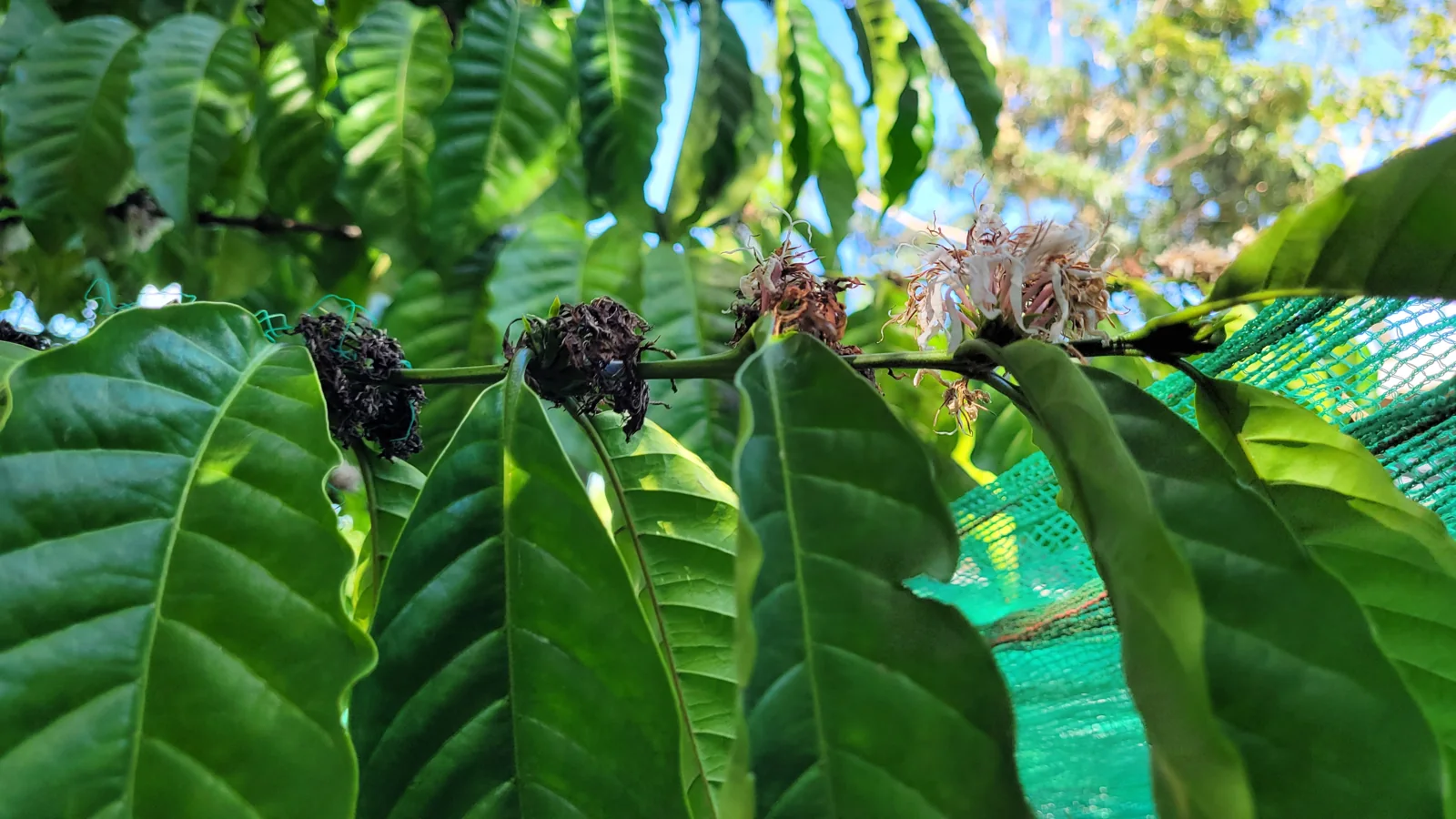
The Philippines grow four commercial species, which is rare: the agricultural research center PCAARRD and the Philippine Coffee Board both write that the country is one of the only ones to produce all four. In 2020, according to the statistics authority cited by the roadmap, the harvest was divided into 41,809 tonnes of dried cherries of Coffea canephora, 14,657 of arabica, 3,712 of excelsa and 463 of liberica, on 86,376, 18,156, 7,430 and 1,303 hectares. For 2023, the Manila press, citing the same authority, gives in green coffee 22,000 tonnes of canephora, 5,955 of arabica, 1,826 of excelsa and 238 of liberica, or about 30,000 tonnes of which 73% is canephora. The International Trade Centre guide makes the country the world’s leading producer of liberica. Excelsa, long classed as the dewevrei variety of liberica, was reinstated in 2025 as a separate species, Coffea dewevrei, by a genomic study that the site presents in its plate on the future of the coffee tree [7][8][9][10][15].
Philippine coffee has become Mindanao coffee. According to the roadmap, the southern island supplies 83.63% of production, of which 35.60% for the Soccsksargen region alone and 9.23% for Northern Mindanao; Luzon now gives only 9.18% and the Visayas, the central islands, 7.2%. Canephora and arabica come mostly from the Davao region and Soccsksargen, excelsa from the former Autonomous Region in Muslim Mindanao and Davao, liberica from Western Visayas and the same autonomous region. Arabica is grown at around 1,000 meters of altitude and above. Most coffee growers farm one to two hectares that they own, intercropped with vegetables, coconut palms, fruit trees or forest trees; large plantations are rare. Nestlé maintains clone gardens, that is, plots where identical plants are multiplied by cuttings, in Davao and Lipa [8].
The coffee year runs from July to June in the tables of the International Coffee Organization. The roadmap describes a picking most often “by stripping,” which pulls all the cherries off the branch in one motion, ripe or green, to get ahead of thieves, at the cost of very low quality; in Kalinga province, in northern Luzon, where wild seedlings are planted, the harvest runs from December to March. The dry process, which dries the whole cherry, dominates for canephora as for arabica, for lack of equipment for the rest; the wet process, rarer, pulps the cherries then ferments the parchment, the envelope around the bean, for 8 to 12 hours in water. Drying is done mostly in the sun, directly on the ground or on paved yards, for two days to two weeks. The World Coffee Research catalog counts the Philippines among the eight countries whose canephora varieties it describes, with two Nestlé Research clones, Roubi 1 and Roubi 2, released in Mexico and the Philippines [7][8][17].
The Department of Agriculture steers the sector through its high-value crops program. Its 2021-2025 roadmap, published in 2022 by its research bureau with the foundation of the University of the Philippines Los Baños, aims at 2 kilos of dried cherries per tree and 164,704 tonnes in 2026, which would raise self-sufficiency from 15% to 39.46%. The Philippine Coffee Board, founded in 2002 under the name National Coffee Development Board, is a private association bringing together producers, roasters, local governments and credit institutions; it has been the local partner of the Coffee Quality Institute since 2016. The country acceded to the 2007 International Coffee Agreement on March 29, 2011, with 0.5% of the votes. Nestlé Philippines, based in Cagayan de Oro, in northern Mindanao, holds 80% of the instant coffee market according to the roadmap [8][11][14].
The Philippines drink far more coffee than they produce. The International Coffee Organization, in the International Trade Centre guide, places them fourteenth among world consumers in 2019 with 2,792,000 60-kilo bags, or about 167,500 tonnes, against twenty-first in 2000. In 2023, Philippine customs declare 47,633 tonnes of green coffee imported for 126.3 million dollars, of which 82.5% from Vietnam and 14.8% from Indonesia, plus 16,909 tonnes of soluble extracts, and only 48 tonnes of green coffee exported. Instant coffee dominates consumption and has replaced, the roadmap says, “nilaga” coffee, boiled at home, while “3 in 1” sachets of coffee, sugar and milk arrive from Indonesia and Thailand. Liberica and excelsa nonetheless sell dear: about 500 pesos a kilo against 160 to 180 for canephora, according to the president of the Philippine Coffee Board in 2024 [7][8][10][13].
- Cultivated species
- Coffea canephora, arabica, excelsa (Coffea dewevrei) and liberica (kapeng barako): 22,000, 5,955, 1,826 and 238 t of green coffee in 2023 [10]
- FAOSTAT production 2024
- 64,000 t, status E (estimate), at the level of dried cherries and not green coffee [1]
- FAOSTAT series maximum
- 171,400 t in 1982, on 135,660 ha [1]
- Main area
- Mindanao, 83.63% of production; Soccsksargen alone 35.60% (2020) [8]
- Peak of the 19th century
- 16,805,000 pounds exported in 1883, about 7,600 t [2]
- Arrival of rust
- Around 1889 according to Ukers, 1890 or 1892 according to McCook [5]
- Green coffee imports 2023
- 47,633 t, of which 82.5% from Vietnam [13]
- International Coffee Organization
- Accession to the 2007 agreement on March 29, 2011 [14]
Gray areas
The FAOSTAT series weighs dried cherries and calls them green coffee. For 2015 and 2020, it takes up exactly the national figures in dried cherries, which weigh about twice the green bean: the International Coffee Organization’s coefficient for going from dried cherry to green is 0.5, and the roadmap applies it. The estimated values for 2023 and 2024 extend this level, 60,000 then 64,000 tonnes, whereas the Manila press reports about 30,000 tonnes of green coffee for 2023, a total that equals the sum of the four species published by the statistics authority. The U.S. Department of Agriculture counts 450,000 bags, or 27,000 tonnes, and the International Coffee Organization 210,000 bags for the 2019 crop year, or 12,600 tonnes. The FAOSTAT figure for 2019 is 4.8 times the ICO’s, and still 2.4 times once halved. Nobody says since when the series has been kept in dried cherries: if it always has been, the 1982 maximum would represent about 86,000 tonnes of green coffee, but no source read makes it possible to assert this, any more than it explains the 1975 jump [1][7][8][10][12].
The share of the four species is not certain. The same roadmap gives three breakdowns: 66% canephora, 25% arabica, 8% excelsa and 1% liberica in its overview; 76.5%, 16.7%, 5.7% and 1.1% in its table of coffee types; whereas the tonnages of that table give 68.9%, 24.2%, 6.1% and 0.8%. The percentages of the table look more like the breakdown of areas than that of harvests. The U.S. Department of Agriculture, for its part, has counted no bags of species other than arabica and canephora since 2010, against 200,000 in 1990: Philippine excelsa and liberica have disappeared from its balances. And the Kew team, according to Daily Coffee News, estimates world production of liberica and excelsa at probably less than 1,000 tonnes, whereas the Philippine authority alone counts more than 2,000 tonnes in green coffee for 2023. The story of barako adds its own confusion: Ukers describes a Lipa coffee that was arabica, and liberica, described in 1876, cannot have arrived at Lipa in the 18th century as one sometimes reads; the date of 1876 at Amadeo has no known primary source [2][8][10][11][12][16].
Consumption is as poorly measured as production. For 2019, the ICO counts 2,792,000 bags consumed and the U.S. Department of Agriculture 6,120,000, more than double, of which 5,000,000 bags of imported instant coffee, the equivalent of 300,000 tonnes of green coffee. Yet customs declare in 2023 only 16,909 tonnes of imported soluble extracts, about 44,000 tonnes of green coffee with the ICO coefficient of 2.6. The “3 in 1” sachets, classed elsewhere in the customs nomenclature, could fill the gap, but nothing that was read verifies it. The roadmap finally writes that the country is 15% self-sufficient and imports 81% of its needs, two figures that do not add up to a hundred, and that it has been a net importer since 1997, whereas Ukers and McCook already described it as an importer at the beginning of the 20th century [2][5][7][8][12][13].
Not covered: The history from 1920 to 1980 (arrival of Nestlé, rise of Mindanao, ICO quotas, cause of the 1975 jump), which only the trade association tells, without sources; the date of the shift of cultivation from Luzon to Mindanao; the arabica varieties grown in the Cordillera and in Mindanao, for lack of a source; the official 2024 figures in green coffee, the statistics authority’s database having answered 403; the annual coffee report of the U.S. Department of Agriculture, not found; the full text of Belamide (Philippine Social Sciences Review, 2020) and of Castro’s thesis (2003), of which only the abstracts were seen; Legarda, After the Galleons, cited by McCook; Ukers’s illustrations (sun drying in Laguna, “Lamoa” station near Manila), in the public domain but whose file I did not locate; per capita consumption, whose table in the ITC guide is illegible by extraction.
- FAOSTAT, Production: Crops and livestock products, Coffee, green (656), FAO, 2025, https://www.fao.org/faostat/en/#data/QCL solid level
Series 1961 to 2024 from pays_producteurs_complement.json (version of December 23, 2025) and year-by-year statuses read in the local copy of the normalized file (elements 5510, 5312, 5412): production with status A from 1961 to 2021, I in 2022 (59,962.36 t), E in 2023 (60,000 t) and 2024 (64,000 t); area with status A over the whole series (115,779 ha in 2024); yield E from 2022 to 2024. 53,031 t in 1974, 91,444 t in 1975 (yield from 816.9 to 1,398.7 kg/ha); maximum 171,400 t in 1982 on 135,660 ha; 72,342 t in 2015; 60,640.95 t in 2020. - All About Coffee, William H. Ukers, The Tea and Coffee Trade Journal Company, 1922, https://www.gutenberg.org/ebooks/28500 solid level
Text copy from the library. P. 9 and chronology: introduction from Java by Spanish missionaries in 1740. P. 241-242: missionaries from Mexico at the end of the 18th century, La Laguna then Batangas and Cavite, arabica, town of “Yipa,” Spanish, British and Hong Kong customers, 16 million pounds in 1883-1884, rust around 1889 (index: “Philippines (1889), 242”), 3,086 pounds exported in 1917, plan of 1915 without follow-up, failure of the Java varieties. P. 284: peak of 16,805,000 pounds in 1883, country become an importer, 2,700 acres and 2,710,000 pounds in 1920. Absence from international trade since 1892 (chapter on commercial coffees, p. 355 according to the index); net imports of 3,475,504 pounds in 1920 (consumption table). - Coffee: From Plantation to Cup, Francis B. Thurber, American Grocer Publishing Association, 1881 medium level
Library copy (Pepites_historiques_et_scientifiques), p. 87-88: prizes of the Economic Society of Luzon then abandoned plantations; exports from Manila, Cebu and Iloilo of 64,391 piculs in 1879 and 83,999 piculs of 140 pounds in 1880, of which 68,942 to continental Europe. Author a merchant compiling second-hand figures, hence the medium level. - Coffee: Its History, Classification and Description, Joseph M. Walsh, Henry T. Coates, 1894 medium level
Library copy, p. 150: competing theories on the origin (Spanish priests from the Malay world, or a wild plant of Luzon); grades Luzon, Manila (Laguna, Batangas, Cavite) and Zamboanga (Mindanao, large bean, thin cup). - Coffee Is Not Forever: A Global History of the Coffee Leaf Rust, Stuart McCook, Ohio University Press, 2019 solid level
Library copy. P. 66: Philippines among Asia’s exporters. P. 68-69 and map 4.1: rust in Luzon in 1890. P. 70: “after the appearance of rust in the Philippines in 1892,” exports of 16 million pounds falling to almost nothing, fourth exporter in the early 1880s, net importer in the early 20th century, worms and root borer. P. 72: cultivation impossible below 800 m according to Wester (1915), conversion to other crops. P. 104: canephora introduced in the Philippines after its success in the Dutch East Indies. - Les caféiers et les cafés dans le monde, tome I, Les caféiers, René Coste, Larose, 1955 solid level
Library copy. P. 61: C. arabica grown in the Philippines (Laguna, Batangas). P. 63: C. canephora grown in the Philippines (Batangas, Cavite, Mountain Province, Iloilo, Negros); the Philippines do not appear in the lists, ending in “etc.,” for liberica and C. dewevrei (excelsa). - The Coffee Guide, 4th edition, International Trade Centre (ITC), with data from the International Coffee Organization, 2021 solid level
Library copy, read with word coordinates. Conversion box (front matter): dried cherry to green × 0.5, instant to green × 2.6. Table 5, p. 88: Philippines (R/A), July-June crop year, 193, 208, 215, 203, 206 and 210 thousand bags for 2014 to 2019. Table 9, p. 96: 985 thousand bags consumed in 2000 (21st rank), 2,792 in 2019 (14th rank). P. 147: liberica grows mostly in Asia, the Philippines being its leading producer. - The Philippine Coffee Industry Roadmap (2021-2025), Department of Agriculture, Bureau of Agricultural Research, by the UPLB Foundation with the Philippine Council for Agriculture and Fisheries; High Value Crops Development Program, 2022, https://hvcdp.da.gov.ph/wp-content/uploads/2023/07/Philippine-Coffee-I solid level
P. 2-3: 60,640.95 t of dried cherries on 113,264.89 ha in 2020, target of 164,704 t and self-sufficiency from 15% to 39.46% in 2026. P. 4: 15% self-sufficiency, 81% imported. P. 6: units (dried cherries of the statistics authority, green coffee). P. 10-11: Mindanao 83.63%, Soccsksargen 35.60%, Northern Mindanao 9.23%, Luzon 9.18%, Visayas 7.2%; breakdown 66/25/8/1; 72,342 t of dried cherries (36,171 t of green) in 2015. P. 12: farms of one to two hectares. P. 13: table of types (76.5/16.7/5.7/1.1%), Nestlé 80% of instant. P. 21-22: tonnages and areas by species, conversion to green by half, regions by species, liberica called kapeng barako. P. 25: net importer since 1997. P. 40-42: Nestlé clone gardens in Davao and Lipa, stripping, harvest from December to March in Kalinga, dry process dominant, fermentation of 8 to 12 h, drying from two days to two weeks. P. 53: instant in place of “nilaga” coffee, sachets from Indonesia and Thailand. - ISP Commodities: Coffee, DOST-PCAARRD (Philippine Council for Agriculture, Aquatic and Natural Resources Research and Development), 2023-2024, https://ispweb.pcaarrd.dost.gov.ph/isp-commodities/coffee/ solid level
From the statistics authority: 60,640.95 t of dried cherries in 2020, insufficient for a demand of about 198,720 t; 0.54 t of dried cherries per hectare in 2021; Soccsksargen 21,007.41 t in 2021; country “among the few” to produce all four types of coffee. - Millennials, Gen Zs perk up coffee production in Philippines, The Philippine Star, 2024, https://www.philstar.com/business/2024/02/20/2334572/millennials-gen-z medium level
From the statistics authority and the Philippine Coffee Board: about 30,000 t of green coffee in 2023 (29,957 t in 2022); 22,000 t of canephora, 5,955 t of arabica, 1,826 t of excelsa, 238.18 t of liberica; prices of about 500 pesos a kilo for liberica and excelsa, 160 to 180 pesos for canephora, according to Chit Juan, president of the Philippine Coffee Board. The unit of the figures by species is not specified, but their sum equals the total in green. - Our Coffee Heritage (Philippine Coffee page), Philippine Coffee Board Inc., accessed in 2026, https://philcoffeeboard.com/philippine-coffee/ low level
Unsourced account: Franciscan monk of Lipa called a myth, Arab traders as a lead, with 1740 up front; first liberica at Amadeo in 1876; pests in 1889 and rust in 1891; resistant variety of the 1950s, surplus and import ban in the 1960s, ICO membership in 1980; four species; association founded in 2002 as the National Coffee Development Board, member of the ASEAN Coffee Federation in 2011, partner of the Coffee Quality Institute in 2016. Used for the association itself and as an example of a repeated story. - Production, Supply and Distribution Online, coffee file (psd_coffee_csv), USDA Foreign Agricultural Service, 2026, https://apps.fas.usda.gov/psdonline/downloads/psd_coffee_csv.zip solid level
File downloaded on October 21, 2026 by another agent working on the same project and reread here. Philippines: production of 450,000 bags in 2019 and 2024 (25,000 of arabica, 425,000 of canephora); other species at 200,000 bags in 1990, nil since 2010; domestic consumption of 6,120,000 bags in 2019; imports of instant coffee of 5,000,000 bags in 2019 and 2024. - UN Comtrade, HS 090111 (unroasted, non-decaffeinated coffee) and HS 210111 (coffee extracts, essences and concentrates), United Nations Statistics Division, 2026, https://comtradeapi.un.org/public/v1/preview/C/A/HS?reporterCode=608&a solid level
Queried on October 21, 2026, declarations by the Philippines for 2023: green coffee imports 47,632,964 kg for 126,265,907 dollars, of which Vietnam 39,300,052 kg and Indonesia 7,060,411 kg (Brazil 639,499 kg); extract imports 16,909,320 kg for 102,533,078 dollars; green coffee exports 47,859 kg, extracts 748,535 kg. - Membership of the International Coffee Organization under the International Coffee Agreement 2007, as at 2 February 2022, International Coffee Organization, 2022, https://www.icocoffee.org/wp-content/uploads/2022/11/membershipica2007 solid level
Philippines among the countries that completed their procedures: accession on March 29, 2011, 0.5% of the votes for entry into force. - Genomic data define species delimitation in Liberica coffee with implications for crop development and conservation, Aaron P. Davis and coauthors, Nature Plants 11, p. 1729-1738, doi 10.1038/s41477-025-02073-y, 2025, https://doi.org/10.1038/s41477-025-02073-y solid level
Full text not opened (the University of Zaragoza repository did not respond). Read through the site’s avenir-09 plate and source 16: three species, C. liberica, C. dewevrei (excelsa) and C. klainei; excelsa ceases to be a variety of liberica. - Study Says Liberica and Excelsa Are Separate Species, With Implications for Cultivation, Nick Brown, Daily Coffee News, 2025, https://dailycoffeenews.com/2025/08/21/study-says-liberica-and-excelsa medium level
Report on source 15: world production of liberica and excelsa “probably less than 1,000 tonnes,” the often-cited share of 1 to 2% coming from data of the late 19th century. The article does not name the Philippines. - Coffee Varieties Catalog, World Coffee Research, 2025, https://varieties.worldcoffeeresearch.org/ solid level
Library copy. P. 5: Philippines among the eight countries covered for canephora. P. 129 and 131: clones Roubi 1 and Roubi 2, breeder Nestlé Research, released in Mexico and the Philippines, highly resistant to rust. - Global Conservation Strategy for Coffee Genetic Resources, Paula Bramel, Sarada Krishnan, Daniela Horna, Brian Lainoff, Christophe Montagnon, Crop Trust, 2017 solid level
Library copy (Varietes_et_genetique), annex II, species list, p. 65: Coffea mabesae, Philippines. - Demythologising the history of coffee in Lipa, Batangas in the XIXth century, Bel Castro, University of Adelaide (thesis), 2003, https://digital.library.adelaide.edu.au/items/9186a96e-1ad5-4707-ab21- medium level
Abstract only, read through the search engine, the record having been impossible to open: the thesis of a Lipa monopoly around 1886-1887 is a myth; deforestation, monoculture, lack of investment and competition from other products would explain the decline better than the disease, which would have accelerated it.