20Mexico
4,200,000 bags (ICO 2009)In-depth country profile: production, varieties, classification, history, current situation and points that remain uncertain. Region: Central America.
Mexican coffee is old, but its export history only really begins at the end of the 19th century. The country is today one of the world's major producers, with production largely oriented toward export.
It is above all a matter of smallholders, very numerous, farming tiny areas. The great terroirs (Veracruz, Chiapas, Oaxaca) spread over a volcanic chain. Notably, Mexico is the world's leading producer of organic arabica, often grown under forest shade.
- Botanical species
- Arabica, Canephora
- Varieties
- Bourbon 20%, Typica 20%, Mundo Novo 20%, Caturra 20%, Garnica 10%, Maragogype
- Altitude
- 500 to 2,000 m
- Shade
- Inga, banana, macadamia, avocado, laurel, mango, wild cacao…
- Harvest
- Manual and selective (picking)
- Processing
- Wet process (mainly); drying on cement patios or in ovens
- Sorting
- Mechanical and electronic, supplemented by hand for higher qualities
- Harvest period
- October to March
- Packaging
- 69 kg bag
Altitude
| Description | Altitude |
| Prime Washed (PW) | 500-1,000 m |
| High Grown (HG) | 1,000-1,600 m |
| Strictly High Grown (SHG) | > 1,700 m |
The higher the altitude, the more acidity and complexity increase. SHG is the best quality in the country.
The region (Veracruz, Oaxaca, Chiapas)
Increasingly mentioned; the name of the “Finca” sometimes appears on contracts.
Quality: number of defects
| Preparation | Max defects (300 g) |
| European (EP) | 15 defects, none major |
| American (USP) | 35 defects |
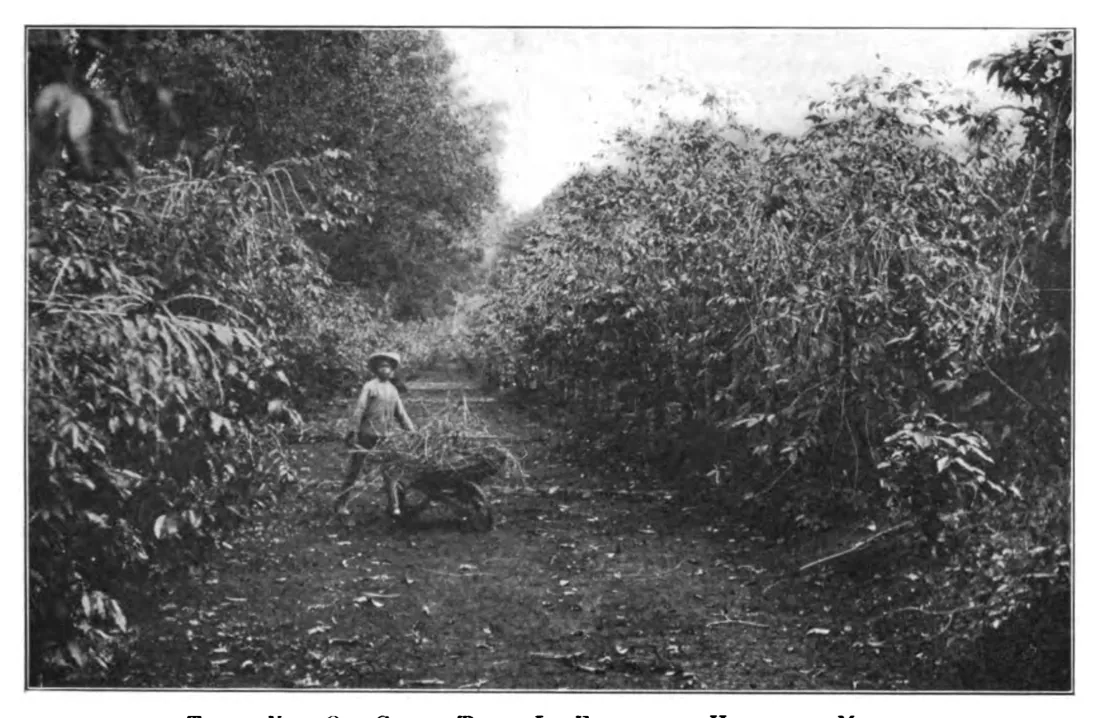
History
Ukers dates the start of cultivation in Mexico to 1790, from seeds coming from the Antilles. Intensive cultivation had to wait until 1817, in the state of Veracruz, under the impetus of Don Juan Antonio Gomez.
Twenty-seven years thus separate the plant from serious planting. Mexican coffee is old, but its trade is much less so.
In 1922, Mexico was the leading producing country of the northern part of the American continent. Its coffee was then described on the market as a greenish to yellow bean, of mild flavor.
Two traits were thus enough to qualify an origin: the color of the bean and a note of taste. The modern profile, for its part, lines up altitudes and defect counts.Ukers, All About Coffee (1922), ch. II, p. 5-10; Ukers 1922, ch. XIX, p. 190-206, p. 193
Ukers, All About Coffee (1922), ch. II, p. 5-10; Ukers 1922, ch. XIX, p. 190-206, p. 193Mexico is one of the three countries whose Big Rust loss has been quantified. It lost 46% of its production over the 2012-2013 episode, against 57% for El Salvador and 39% for Peru.
The timing aggravated the blow. While these harvests were disappearing, the world price fell from three dollars a pound in early 2011 to under 1.50 dollars in June 2013.
Producers thus lost twice: fewer bags to sell, and each bag sold for less.LC ch. 16; McCook 2019
LC ch. 16; McCook 2019Today
The volume at the head of the profile, 4,200,000 bags, is that of the profile (ICO 2009).
The varieties declared are Bourbon (20%), Typica (20%), Mundo Novo (20%) and Caturra (20%). To these are added Garnica (10%) and Maragogype. The orchard extends between 500 and 2,000 meters.
Garnica is a Mundo Novo by Caturra cross selected in Mexico. The country therefore does not merely import lineages, it makes them.
The national institute has also released Oro Azteca, a Mexican Catimor, and INIFAP canephora selections.Country Profiles, Marco De Sousa Rosa, 2026; World Coffee Research, Coffee Varieties Catalog 2025, Garnica, Oro Azteca, INIFAP profiles
Country Profiles, Marco De Sousa Rosa, 2026; World Coffee Research, Coffee Varieties Catalog 2025, Garnica, Oro Azteca, INIFAP profilesThe sector is made up of very numerous smallholders, farming tiny areas on a volcanic chain: Veracruz, Chiapas, Oaxaca. Mexico is the world's leading producer of organic arabica, often grown under forest shade, and harvesting is by picking, with drying on cement patios or in ovens.
Country Profiles, Marco De Sousa Rosa, 2026Gray areas
- No Mexican production volume after 2009 could be sourced.
- Mexico's world rank in organic arabica comes from the profile and has not been cross-checked.
- The release date of Garnica is not given by the varieties catalog.
- The share of the Mexican orchard replanted after the Big Rust is not quantified here.