34India
4,827,000 bags (ICO 2009)In-depth country profile: production, varieties, classification, history, current situation and points that remain uncertain. Region: Asia.
In India, coffee growing is said to have been born more than four centuries ago: legend attributes to a pilgrim, Baba Budan, the importation of arabica seeds from Yemen. But real production only developed under English colonization, around 1840. The country is today the world's fifth-largest producer.
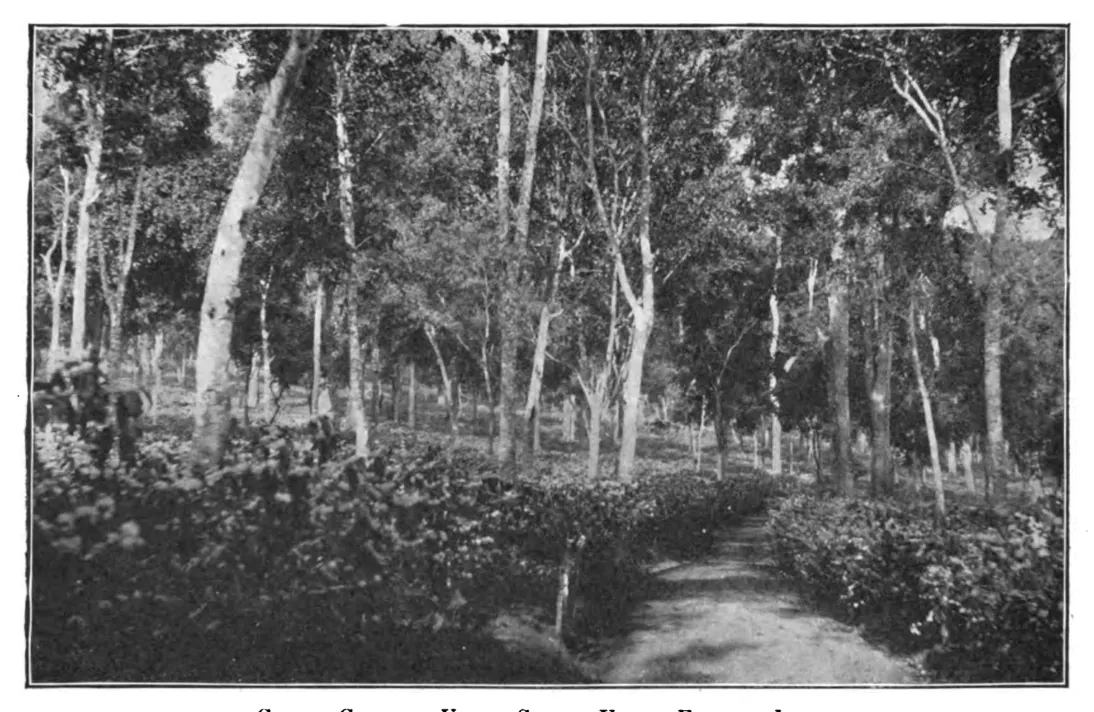
Coffee is concentrated in the three southern States (Karnataka, Kerala, Tamil Nadu), grown under very varied forest shade and associated with other crops (cardamom, pepper, citrus) that contribute to the aromatic profile. Local enthusiasm is such that India ends up importing coffee. A few coffees are unique in the world, such as Monsooned Malabar, whitened by the monsoon winds.
- Botanical species
- Arabica (40%), Canephora (60%)
- Altitude
- 600 to 2,000 m
- Shade
- Banana, pepper, cardamom, orange, vanilla, ginger, mango…
- Harvest
- Manual and selective (picking)
- Processing
- Wet process; natural drying
- Sorting
- Mechanical and manual
- Harvest period
- November to March
- Packaging
- 60-kg bag
Recent volume 3.7 million bags in 2024-2025USDA FAS, 2025
The Indian system rests on a set of grades tied to processing and preparation, often accompanied by the terroir or the name of the plantation.
Processing vocabulary
Cherry = natural coffee (robusta or arabica); Parchment = washed robusta; Plantation = washed arabica.
Canephora (natural and washed)
| Grade | Criteria |
| Cherry AA | Natural, sorted; 90% retained on screen 18; sorting tolerance 3% |
| Cherry A | Natural, sorted; 90% retained on screen 17; tolerance 3% |
| Cherry / Parchment AB | Natural and washed, sorted; 90% retained on screen 15; tolerance 3% |
| Cherry / Parchment PB | Sorted, not screened; tolerance 3% |
| Cherry / Parchment Bulk | Unsorted, not screened; tolerance 10% |
| Cherry / Parchment C | Unsorted, not screened |
Natural arabica
| Grade | Criteria |
| Cherry AB | Sorted; 90% retained on screen 15; tolerance 3% |
| Cherry PB | Sorted, not screened; tolerance 3% |
| Cherry Bulk | Unsorted, not screened; tolerance 18% |
| Cherry C | Unsorted; 75% retained on screen 14 |
Washed arabica (Plantation)
| Grade | Criteria |
| Plantation A | Sorted; 90% retained on screen 17; tolerance 2% |
| Plantation B | Sorted; 75% retained on screen 15; tolerance 3% |
| Plantation C | Unsorted; 75% retained on screen 14 |
History
Legend · Indian tradition attributes the introduction of coffee to Baba Budan, a Muslim pilgrim who is said to have brought back seven seeds from Yemen and planted them near his hut at Chikmagalur, in the Mysore mountains. Ukers gives the tradition as 1600 but specifies that a better authority gives 1695; he adds that he saw on the spot the descendants of those first plants, under centuries-old jungle trees. English cultivation, for its part, only begins in 1840.
Ukers, All About Coffee (1922), ch. II, p. 5-10; LC ch. 6; professional training document, L'Histoire du caféIndia is the first stage outside Arabia on the coffee route, and this position gives it a role in the whole genealogy that follows.
It is from Malabar that, in 1696, the plants sent to Java by Adrian Van Ommen departed, at the instigation of the burgomaster of Amsterdam Nicolaas Witsen.
Then, in 1699, the cuttings of Henricus Zwaardecroon departed. They are the ones that would become the ancestors of all the coffees of the Dutch East Indies. The Malabar coast is therefore the source of Dutch colonial coffee.
Rust, for its part, struck India in 1872. That is three years after Ceylon, which gives the measure of the speed at which the fungus spread across the continent.
Ukers, All About Coffee (1922), ch. II, p. 5-10; LC ch. 8, 12 and 13India also supplied the first resistances. Kent, a selection by L. P. Kent at the Doddengudda estate in Mysore between 1911 and 1920, is the first variety to show a tolerance to rust, since overcome, and it was distributed to East Africa and Java. S.288 followed in 1936-1937, then S.795 in 1945-1946, a cross of S.288 and Kent, the first widely distributed resistant variety, known in Indonesia as Jember. Sln.6, or CxR, crosses the canephora S.274 with tetraploidized Kent, and Cauvery is the Indian Catimor, received from CIFC in 1985.
World Coffee Research, Coffee Varieties Catalog 2025, Kent, S.288, S.795, Sln.6, Cauvery profiles; Central Coffee Research Institute, Coffee Board of IndiaToday
The volume at the head of the profile, 4,827,000 bags, is that of the profile (ICO 2009). The USDA gives 3.7 million bags for 2024-2025: the two figures do not cover the same seasons and cannot be compared directly.
Production is concentrated in the three Southern states: Karnataka, Kerala and Tamil Nadu. It is tiered between 600 and 2,000 meters.
Coffee grows there under varied forest shade, associated with cardamom, pepper and citrus. These neighboring crops are not decorative: they take part in the aromatics of the cup.
Harvesting is by hand, by picking, taking only the ripe cherries. Processing combines the wet process and natural drying.
Country Profiles, Marco De Sousa Rosa, 2026; USDA FAS, 2025India also produces one of the strangest coffees in world trade: Monsooned Malabar, arabica or canephora exposed for several weeks to monsoon winds in open warehouses, until the bean swells and whitens. Its neighbor Old Brown Java follows the same logic of directed aging.
LC ch. 17b; professional training document, Malabar guideGray areas
- The date of the introduction by Baba Budan oscillates between 1600 and 1695 depending on the authorities, and the account itself is a tradition.
- The claim, taken from a training document, that India became the “world's leading producer” two centuries after Baba Budan is corroborated by no source in the corpus and appears false.
- The moisture content and the exact duration of Malabar monsooning are not established: the sources give incompatible ranges.
- The share of Indian production now consumed locally is not quantified here.