06Ethiopia
4,500,000 bagsIn-depth country profile: production, varieties, classification, history, current situation and points still uncertain. Region: Africa.
Birthplace of coffee, Ethiopia grows only arabica, between 1,500 and 2,300 meters. These coffees are called “the Mochas,” in memory of the port of Mocha from which they once left. Behind this name actually lies a great diversity of crus, depending on the region and the processing method.
Coffee remains central to the country's economy: 5th largest producer in the world, with a large share of production exported. About 80% of coffees are natural, dried by the dry process. Notably, almost no chemical inputs are used; the country could lay claim to organic, but certification is judged too costly.
As for the origin of coffee, a legend attributes it to a shepherd, Kaldi, intrigued by his goats that had become quite lively after eating a few seeds.
- Botanical species
- Arabica
- Varieties
- Mocha and its derivatives, depending on altitude and terroir
- Altitude
- 1,500 to 2,300 m
- Shade
- Forest and fruit trees
- Harvest
- Manual and selective
- Processing
- Wet process and dry process
- Sorting
- Manual
- Harvest period
- October to April and August to December
- Packaging
- 60-kg bag
Recent volume 11.6 million bags in 2025-2026, a record (7.0 according to the ICO for 2024-2025: definitions of year and scope differ)USDA FAS, June 2025; ICO, reports 2024-2025
Ethiopia's “Mocha” coffees are described by two elements: the “cru” and the number of defects.
The “cru”
The cru is defined by two things at once: the region of production and the processing method. The same region therefore yields several crus, depending on whether the cherry is washed or dried whole.
Kaffa is the example. There one finds washed Mochas, designated “Mocha Limu,” and dried Mochas, designated “Mocha Djimmah.” The sales name thus carries what the grade does not say: the grade counts defects, the cru says where the coffee comes from and how it was prepared.
Number of defects (300 g sample)
| Grade | Number of defects |
| Grade 1 | 0 to 3 |
| Grade 2 | 4 to 12 |
| Grade 3 | 13 to 25 |
| Grade 4 | 20 to 45 |
| Grade 5 | 46 to 100 |
| Grade 6 | 101 to 153 |
| Grade 7 | 154 to 340 |
| Grade 8 | more than 340 |
Export of the last two grades (7 and 8) is prohibited.
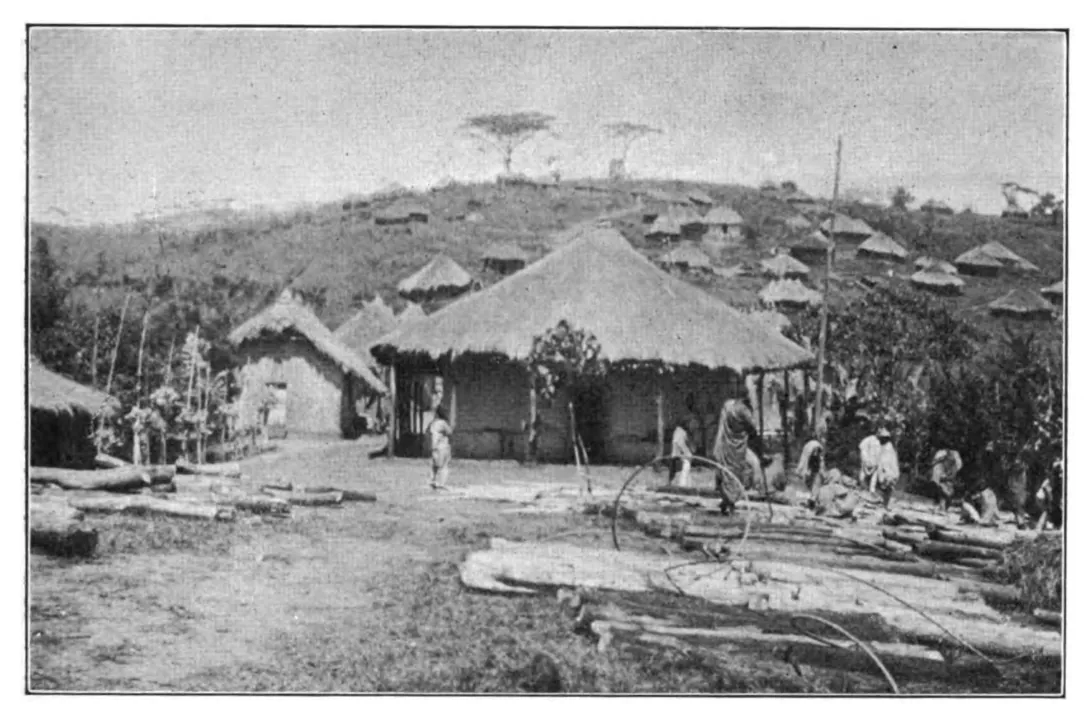
History
Ethiopia is the cradle of the species, and the only origin where arabica grows wild. From this follows a particularity that no other country shares: coffee is harvested there that no one planted.
In 1922, Ukers already distinguishes two Ethiopian coffees, and he separates them on precisely this point. Harari comes from cultivated trees, in the province of Harar. Abyssinian, or Kaffa, comes from wild trees, in the provinces of Sidamo, Kaffa and Guma.
He describes immense forests where the inhabitants gather the fallen beans. The average annual harvest of this wild coffee is around 6,000 bags.
It remained to get this coffee out of the country, and the route shows the effort that took: by mule to Dire Dawa, then by rail to Djibouti.
Ukers 1922, ch. XX, p. 216-244, p. 240-241Legend · The origin of coffee is attributed to a shepherd, Kaldi, whose goats are said to have started dancing after browsing red berries. Ukers classes it among the legendary accounts, and the historical treatise appended to La Roque, translated in 1732, already took it apart.
Ukers 1922, ch. II-III and chronology p. 725 (“legend”); La Roque, Voyage de l'Arabie heureuse (1716, trans. 1732); LC ch. 5Ethiopian genetic material has irrigated the world twice, and the two passages are nothing alike.
The first goes through Yemen. From there come the two founders, Typica and Bourbon, that is, the stocks from which most cultivated varieties descend.
The second is deliberate: people go to Ethiopia to find material to feed breeding programs. A British mission collected wild seeds in 1931 for the programs of Kenya, Uganda and Tanganyika. In this lot there is an accession labeled Geisha.
The later collections are institutional. The FAO passed through in 1964-1965, ORSTOM in 1966, and they brought back the Agaro, Dilla, Gimma and Kaffa accessions. These four names still feed breeding programs, which makes Ethiopia a supplier of genes as much as a producing country.
World Coffee Research, Coffee Varieties Catalog 2025, Geisha and FAO 1964-65 / ORSTOM 1966 Accessions profiles; LC ch. 3 and 8Today
The country grows only arabica, between 1,500 and 2,300 meters, in the dry process for about 80% of lots. The trade name remains “Mocha,” in memory of the Yemeni port from which these coffees left. Almost no chemical inputs are used: the country could lay claim to organic, but certification is judged too costly. The varieties are the local populations and selections from the national Jimma program, the JARC, which has distributed numbered lineages (74110, 74112, 74158) since 1967, then named selections such as Sende and Limu 1.
Country Profiles, Marco De Sousa Rosa, 2026; World Coffee Research, Coffee Varieties Catalog 2025, JARC profiles; LC ch. 8Domestic trade was overhauled in April 2008 with the creation of the Ethiopian Commodity Exchange, the first commodity exchange in Africa, under the direction of Eleni Gabre-Madhin.
An exchange works by making lots interchangeable: one buys a grade and a region, not a farm. That is exactly what specialty coffee buyers held against it. By erasing traceability at the farm level, the ECX also erased the means of paying more to an identified producer.
The ECX opened a direct channel, then, from 2017, a direct specialty license that preserves traceability.
An earlier episode had shown what was at stake. In 2007, after a dispute over the Sidamo, Harar and Yirgacheffe trademarks filed by Ethiopia, Starbucks signed a licensing agreement with Addis Ababa. The name of an origin is worth something, and that is why people fight over which farm a bag comes from.
Perfect Daily Grind, What Is The Ethiopian Commodity Exchange?, October 2020; Collaborative Coffee Source, Changes to the Ethiopian Commodities Exchange, April 2018; LC ch. 19Gray areas
- Ethiopian production figures diverge depending on the source and the definition of year: the USDA reports 11.6 million bags for 2025-2026, the ICO 7.0 million for 2024-2025. The two do not measure the same thing.
- The exact share of wild, semi-forest and cultivated coffee in Ethiopian production is not stably established.
- The number of distinct varieties grown in Ethiopia is unknown: the orchards are populations, not lineages.
- The net effect of the ECX on producers' income is not settled by the sources consulted.