29Colombia
8,500,000 bags (ICO 2009)In-depth country profile: production, varieties, classification, history, current situation and points still uncertain. Region: South America.
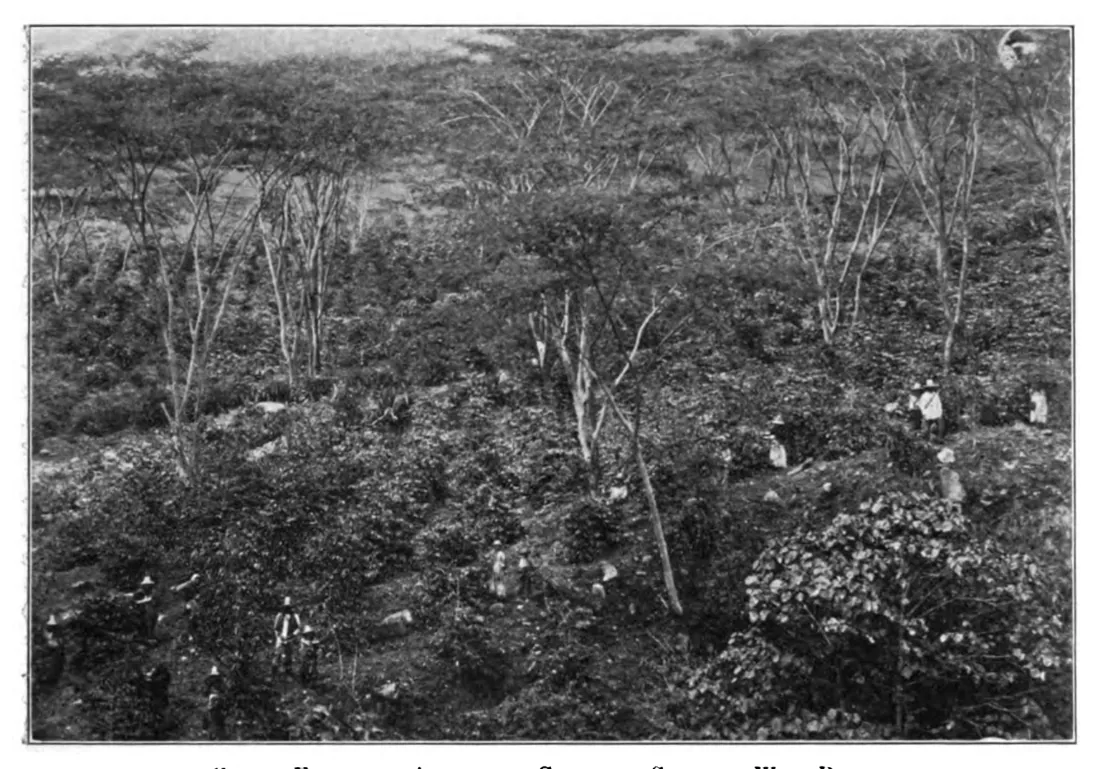
Colombia is the world's leading producer of washed arabica, in the jargon “Mild Washed Arabica.” It is a deliberate choice: the country works almost exclusively by the wet process, betting on quality. The production zones stretch from north to south, in the Andes mountains.
Half a million families live directly from coffee growing. The sector has been overseen since 1927 by the National Federation of Coffee Growers, whose action covers the farm as much as rural communities, the environment and the training of young people. A monitoring system (SICA) and the Cenicafé research center serve as the technical reference for producers.
- Botanical species
- Arabica
- Altitude
- 800 to 1,900 m
- Shade
- Fruit and forest trees
- Harvest
- Manual and selective
- Processing
- Wet process; drying on cement patios or in ovens
- Sorting
- Gravity and color sorting; screen grading
- Harvest period
- MainSept. to Dec.; second (mitaca): a few months later
- Packaging
- 70 kg bag
Recent volume 14.87 million bags over the October 2024-September 2025 coffee year, the highest in 33 years; 13.67 million over calendar year 2025, down 2%Federación Nacional de Cafeteros, 2025 reviews (Semana, Portafolio, La República)
Number of defects
Two groups: Group 1 (defects that alter the taste: stinker, immature, black beans) and Group 2 (defects of appearance and roast loss). Ratio of 1 to 10: one Group 1 defect counts as 10 Group 2 defects. In 500 g, export allows 72 defects (private exporters) or 42 (the Federation).
Specialty coffees: by grade
| Grade | Criteria |
| AA | 0 group 1 defects; 5 max from group 2; no Broca or insects |
| A | 3 max from group 1; 8 max from group 2 |
Bean size
| Designation | Criteria |
| Maragogype | “Giant” beans (variety), very low volume, Medellín region |
| Supremo 18+ | Max 5% < screen 18; 100% > screen 14 |
| Supremo | Max 5% < screen 17; 100% > screen 14 |
| Excelso Extra | Max 5% < screen 16; 100% > screen 14 |
| Excelso | Max 2.5% < screen 15; 100% > screen 12 |
| UGQ (Usual Good Quality) | Max 1.5% < screen 14; 100% > screen 12 |
Traditionally sold in Medellín/Armenia as Excelso or Supremo type. Increasingly, the terroir is named: Quindío, Popayán, Bucaramanga, Huila, Tolima, Nariño…
History
The oldest written testimony of coffee in Colombia is that of the Jesuit José Gumilla. Around 1730 he notes the presence of the plant at the mission of Santa Teresa de Tabajé, near the mouth of the Meta.
A written testimony does not date an introduction. It says only that at that date the plant was there, which makes it the oldest benchmark available.
Legend · The tradition of Salazar de las Palmas, in Norte de Santander, has it that Father Francisco Romero imposed on his parishioners an agricultural penance: plant three or four coffee trees per sin confessed. The archbishop is said to have made it a general practice.
The Federación Nacional de Cafeteros takes up the story, but it has no primary source. Nothing therefore makes it possible to know whether anything of the kind happened.
Gumilla, El Orinoco ilustrado (1741, written around 1730); oral tradition of Salazar de las Palmas taken up by the Federación Nacional de Cafeteros; professional training document, L'Histoire du caféIn 1922, Ukers notes that Colombian foreign trade statistics are too irregular to compare before and after the war. In other words, no series makes it possible to measure what the war changed.
He nonetheless records where the coffee went: England, France, Germany and the United States took most of the exports.
The modern structure of the sector dates from 1927 and the founding of the Federación Nacional de Cafeteros. It organizes the producers and guarantees the purchase, which, for a grower, means he always finds a buyer.
In 1938, the Federación acquired its research center, Cenicafé. From then on the country held the two tools it would use afterward: a producers' organization and a laboratory.
In 1959, the Federación created the character of Juan Valdez with the Doyle Dane Bernbach agency. A country becomes a brand.
Ukers 1922, ch. XIX, p. 190-206, p. 195-196; Federación Nacional de Cafeteros, history; CenicaféColombia is the country that has invested most in rust resistance, and this shows in its varieties. Cenicafé released Variedad Colombia in 1982, a composite of Caturra lineages crossed with Timor Hybrid HdT 1343 in the F5 generation, a year before rust arrived in the country in 1983; then Tabi in 2002, Castillo in 2005, which occupies more than 40% of the Colombian orchard, and Cenicafé 1 in 2016. Between 2007 and 2011, the country nevertheless lost about a third of its production to the Big Rust, and a large part of the orchard was replanted in the years that followed.
World Coffee Research, Coffee Varieties Catalog 2025, Variedad Colombia, Tabi, Castillo, Cenicafé 1 profiles; McCook 2019, p. 171; LC ch. 16Today
The volume at the head of the profile, 8,500,000 bags, is that of the profile (ICO 2009). The country is the world's leading producer of washed arabica, the “Mild Washed Arabica,” and works almost exclusively by the wet process, between 800 and 1,900 meters, with selective manual harvesting, with drying on cement patios or in ovens. Half a million families live directly from coffee growing; a farm information system, SICA, and Cenicafé serve as the technical reference.
Country Profiles, Marco De Sousa Rosa, 2026The country also supplies a large share of the recent specialty varieties whose identity has been revised through genotyping, that is, by reading markers in their DNA.
The Huila Pink Bourbon is not a Bourbon. Two DNA tests make it an Ethiopian landrace, in other words a local population cultivated for a long time without going through selection.
The Urrao Chiroso has met the same fate. It had long been taken for a Caturra mutation; genotyping linked it to the “Core Ethiopia” group.
Both corrections point the same way, toward Ethiopia. The name a coffee carries therefore does not always say where the plant comes from.
World Coffee Research, Coffee Varieties Catalog 2025, Pink Bourbon and Chiroso profiles; DNA Analytica 2017; RD2 Vision 2023Gray areas
- The story of Father Romero is a legend without a primary source; the Federación itself presents it as a tradition.
- The figure of 33% loss between 2007 and 2011 is an order of magnitude taken from the literature, not a plot-by-plot count.
- The exact share of Castillo in the orchard changes every year; the 40% figure comes from the variety profile.
- The genetic identity of Pink Bourbon and Chiroso is established by commercial tests, not by a peer-reviewed publication.