ATLASCape Verde
14 tonnes (FAOSTAT 2024)In-depth dossier, atlas 2026In-depth dossier: the FAOSTAT series compared with the other figures, the history, today's sector and its gray areas, numbered sources. Region: Africa.
Cape Verde had only a statistical reference point. This dossier completes it: the history of the sector, what it is today, and what remains uncertain, each paragraph pointing to its sources, numbered at the bottom of the page.
The FAOSTAT series remains displayed as is. The dossier says what it is worth, year by year when possible, and compares it with the other figures available.
- Geographic status
- country
- Name in FAOSTAT
- Cabo Verde
- Latest value
- 14 tonnes in 2024
- Nature of the value
- official figure
- Start of the positive series
- 1961
- Series maximum
- 185 tonnes in 1971
Confirmed coverage: FAOSTAT series, and a dossier of 14 sources that crosses the history, today's sector and what remains uncertain.
History
The archipelago of Cape Verde was uninhabited when the Portuguese began to settle it, through Santiago, in 1462, and the coffee plant arrived much later, through several islands at once. The oldest testimony noted by the historian A. d. C. Souza is that of the botanist Fusée-Aublet, who describes at Santiago, on March 1, 1754, coffee plants of about five feet planted in the shelter of large trees and laden with fruit. Cultivation did not take hold, however, until the 1790s: a memoir of the time reports that three or four inhabitants of Santiago began growing coffee in the regadios, that is, the irrigated lands, and that on São Nicolau a Portuguese settled on the island sowed a few seeds from the West Indies, from which five plants were born. In January 1803, the intendant António Pusich already estimated the coffee plants of São Nicolau at 3,000 and ranked coffee first among the colony's products, at 14:000$000 réis, ahead of maize and the vine. Fogo appears in none of these documents [3].
Lisbon recommended coffee growing in Cape Verde in 1803, and a Junta de Agricultura was created in 1812 by royal order to develop it, with “agronomic societies” on the islands. Souza nevertheless notes a silence: from 1803 to 1826, the governors' correspondence says nothing of coffee production, although it is held to be the archipelago's first wealth. It reappears in 1826 in a petition from 22 Lisbon merchants, who explain the “unproductiveness” of the islands by taxation: the arroba of Cape Verde coffee, a measure of about 15 kilos, comes to nearly 1$800 réis in Lisbon whereas Brazil's barely exceeds 600 réis, because the products of the African possessions paid 30% in duties, reduced to 10% only in 1829. Souza concludes that cultivation was held back by the mother country's preference for Brazilian coffee, by long droughts and by the morgadios, those large estates concentrated in few hands and left unworked [3].
In the 19th century, coffee remained a crop on several islands. The sailing directions of Kerhallet and Le Gras, translated by the US hydrographic office in 1873, rank it among the main exports of the two island groups and credit Santo Antão, the island with the most productive soil, with about a thousand quintals of excellent coffee, half of which is exported; their description of Fogo says nothing of it. In 1920, the British Foreign Office handbook on the archipelago makes coffee Cape Verde's leading export, paid for in Lisbon at a higher price than all other West African coffees, and says it is grown mainly on Santo Antão, Fogo and Santiago. It adds two structural traits: the smallholder system prevents enough from being harvested for the foreign market, and wherever it is grown, coffee remains under the owner's control, who has it worked on his own account, whereas the purgueira, a shrub whose seeds yield an oil for soap and grease, is grown by sharecropping for half the harvest. Coffee and purgueira together make up roughly three quarters of exports [5][4].
Ukers gives the measure of this period. In his table of exports of the producing countries, the Cape Verde islands shipped 1,442,910 pounds of coffee in 1916, or about 654 tonnes, for a five-year average of 1,100,095 pounds, about 499 tonnes; in his text, he counts them among the largest African producers, just after former German East Africa and ahead of Madagascar, Eritrea or São Tomé. That is three and a half times the highest level FAOSTAT will record after 1961. A 2019 Lusa agency dispatch takes up a similar order of magnitude for the island of Fogo alone, 500 tonnes in 1900 down to about a hundred tonnes a year a century later, then less still because of a prolonged drought, without citing a source. The same dispatch gives the current plantation about two hundred years, on the slope of the volcano, and reports that in 1934 the coffee of Fogo was judged the best of the Portuguese empire [2][8].
The FAOSTAT series begins in 1961 at 52 tonnes and peaks at 185 tonnes in 1971, with year-to-year swings that only a very small production makes possible, like the 8 tonnes of 1973 between 76 and 71 tonnes. It then declines in round steps, 50 or 100 tonnes in the 1980s, down to 10 tonnes in 1991. Then it stops: FAOSTAT enters an estimated zero for 1992 and no value from 1993 to 2010. It resumes in 2011 at 62 tonnes, oscillates between 40 and 88 tonnes until 2022, and falls to 17.17 tonnes in 2023 then to 14 tonnes in 2024, all these recent values being official figures. The atlas's current statistical reference point, which has the series start in 1961, does not flag this eighteen-year gap [1].
Today
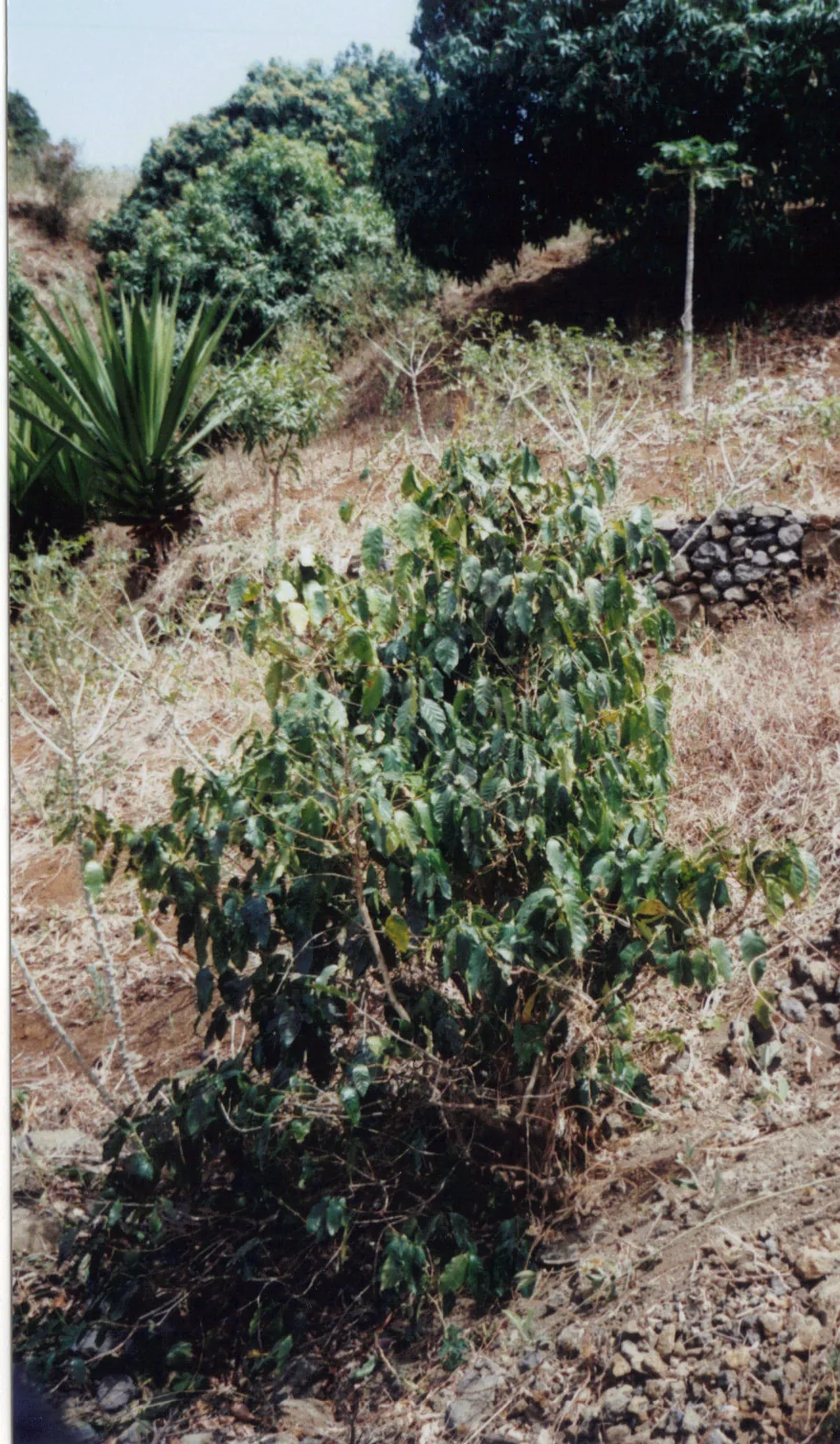
Recent sources speak only of the island of Fogo, and more precisely of the municipality of Mosteiros, on the northeast flank of the volcano whose peak reaches almost 2,900 meters. According to the administrator of the company Fogo Coffee Spirit, cited by Lusa in 2019, dozens of smallholders grow the coffee plant there between 350 and 1,300 meters, dry, that is, without irrigation, and without chemical fertilizer. Barista Magazine places cultivation higher, between 3,000 and 5,000 feet, or about 900 to 1,500 meters, and describes old coffee plants mixed with papaya and banana trees, often planted like the vine in a hole dug in the lapilli, those black volcanic scoriae on which night humidity condenses and then drips toward the plant [8][10].
Coffee is not a crop of Chã das Caldeiras, the highland plain enclosed in the caldera, that is, the great collapsed crater at the foot of the peak. The study of damage from the 2014-2015 eruption inventories vegetables, fruit trees and vines there, the vine being the highest-value crop, without a word on coffee; the flows buried about a quarter of the arable land there. The link with Chã is commercial: according to Wikipedia, the village's farming association roasts and sells under the name Café das Caldeiras a coffee grown on the north flank [11][13].
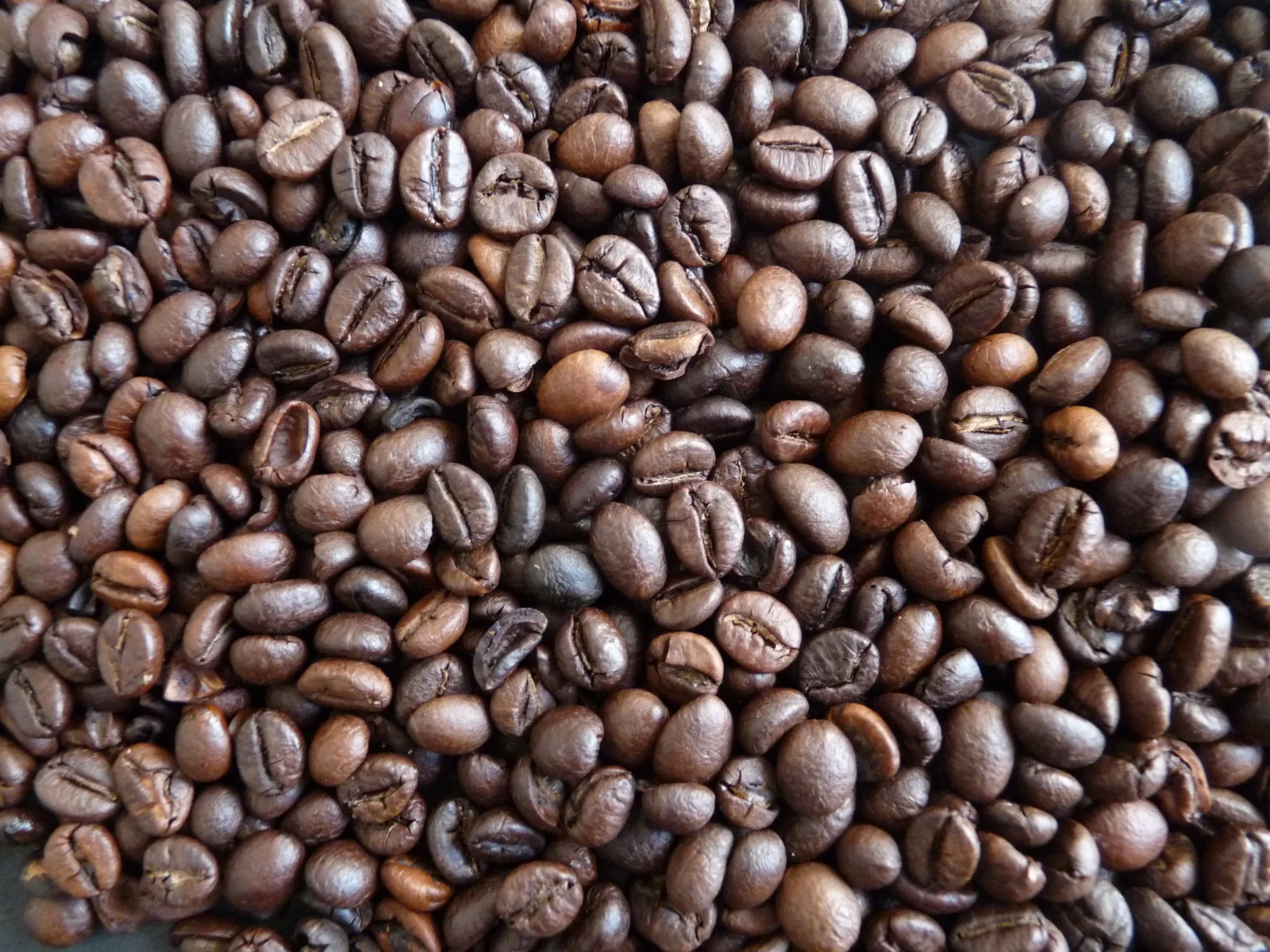
Barista Magazine writes that this coffee is still entirely of the species Coffea arabica; no source found names the cultivated varieties or has analyzed them. Fogo Coffee Spirit, founded in 2011, buys coffee from producers still in cherry to gather volumes, and processes it in two ways: by the dry process, the traditional method, where the cherry dries whole, and by the wet process, which removes the pulp before drying, in a group facility in the mountains; its Mosteiros plant sorts and packs. The harvest takes place from February to April, according to the Mosteiros town hall. The company also planned to develop an infusion of dried pulp, casca de café tea, until then rudimentary on the island [10][8][6].
Exports were made, and in part still are, producer by producer and through Cape Verdean emigrants, explains Fogo Coffee Spirit, 51% owned by the Dutch trader Trabocca and 49% by the Cape Verdean company Capital Consulting, and associated with the Associação dos Produtores do Café dos Mosteiros, known as Pro Café. In 2015, the Inforpress agency announced a first sale of 6,960 kilos to Starbucks, under a phytosanitary certificate from the Ministry of Rural Development at Fogo, after sales to Japan, Russia, the Netherlands, Germany and Italy, and put current production at 30 tonnes a year on average, with the goal of 300 tonnes in ten years. In 2019, Lusa reports that the plant processed 11 tonnes in 2018 and barely more than one tonne at the March 2019 harvest, after three years of low rainfall; when the harvest drops, producers prefer to store their coffee while waiting for a better price. Cape Verde is not a member of the International Coffee Organization: it is among the governments invited as observers to the session that negotiated the 2022 agreement [8][9][12].
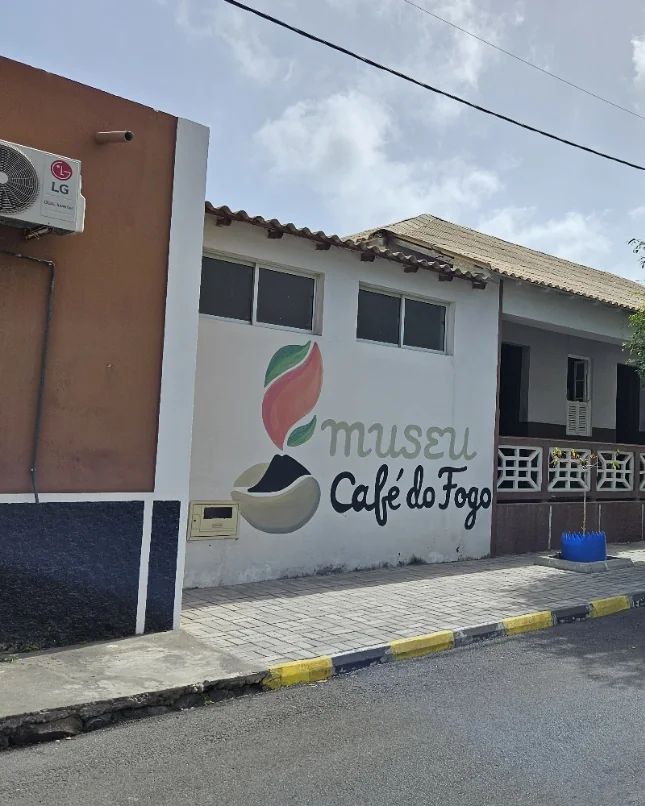
On the ground, the town hall of Mosteiros wanted to give coffee a festival. In 2014 it created the Festival do Café do Fogo, held every year at Igreja, the chief town of the municipality, in the last weeks of the harvest, so that coffee growers can come and guests can watch the picking. Its two highlights are the café da manhã and the café da tarde, meals where coffee accompanies batanquinha, a preparation of sweet potato and cornmeal, corn cuscuz, cheese and banana. The same year, the municipality presented a Fogo Coffee Museum, installed in the former health delegation, and its president asked the Ministry of Agriculture and Rural Development to help extend the plantations, in quantity as in quality [6][7].
- Species cited
- Coffea arabica, varieties not documented [10]
- Growing area
- municipality of Mosteiros, northeast flank of the Fogo volcano [8]
- Growing altitude
- 350 to 1,300 m according to the main buyer [8]
- Harvest
- February to April at Mosteiros [6]
- FAOSTAT production 2024
- 14 t, official figure; imputed area [1]
- FAOSTAT series maximum
- 185 t in 1971; no value from 1993 to 2010 [1]
- Exports in 1916
- 1,442,910 pounds, about 654 t [2]
- International Coffee Organization
- not a member, invited as observer [12]
Gray areas
The official production figure hides an area and a yield that are not official. Since 2011, FAOSTAT has qualified production each year as an official figure, but the harvested area is imputed, except in 2012 and 2013 when it is estimated, and the yield is estimated throughout: it rises almost steadily from 204.3 kilos per hectare in 2014 to 231.8 in 2024, a model curve rather than a measurement. The area is deduced from it, 14 tonnes divided by 231.8 kilos giving the 60 hectares of 2024, and therefore teaches nothing. Before 1992, the series mixes official figures, values taken from an outside organization (1966 to 1968, 1974 and 1975) and estimates (1982 to 1984), with areas frozen at 200 hectares from 1978 to 1984 then at 180 hectares until 1991. From 1993 to 2010, the years carry status M, which the FAOSTAT status table defines as “missing value; data cannot exist,” as if cultivation had ceased; yet Lusa speaks of about a hundred tonnes a year around 2000. No one explains whether this gap reflects a nil harvest or a country that no longer reported anything [1][8].
The tonnages do not overlap. For 2018 and 2019, FAOSTAT gives 46 then 40 tonnes, official figures, whereas the Fogo Coffee Spirit plant processes 11 tonnes then a little over one; in 2015, Inforpress speaks of 30 tonnes of average production whereas FAOSTAT counts 52 to 62 from 2011 to 2015. The two measures may not cover the same thing, one company against the whole country, green coffee against cherry or parchment, that is, the covering around the bean, but no source specifies the unit. It is also unknown whether the national figure covers islands other than Fogo, although Santiago, São Nicolau and Santo Antão were coffee islands in the 19th century and the 1920 handbook still cites Santo Antão and Santiago alongside Fogo. The drop from 47 to 14 tonnes between 2022 and 2024, or 70%, is explained by no source found; drought would be a possible cause, not demonstrated. Finally, no publication of the National Statistics Institute or the Ministry of Agriculture quantifies coffee in what could be consulted: the presentation of the 2015 agricultural census does not mention it, and the institute's site does not display without a browser [1][8][9][4][5][14].
Several accounts are repeated without a primary document. The “best coffee of the Portuguese empire,” the gold medals of the Colonial Exhibition of Porto in 1934 and of Lisbon in 1949, the presentation at a Paris world's fair come from press dispatches that cite no document. The age varies depending on who speaks, two hundred years for Lusa, at least three hundred for Barista Magazine, whereas the archives read by Souza place the first coffee plants at Santiago in 1754 and the sources read here do not cite Fogo coffee before the British handbook of 1920. That same handbook judges Cape Verde coffee so rich in caffeine that many consumers cut it with three or four times its weight of a milder coffee; no measurement supports it. Finally, the idea that this coffee is mainly drunk on the spot and sold to visitors is established by no source: Barista Magazine writes that it is most often exported to be roasted elsewhere, to the point of being hard to find on the island, and no one has measured the share consumed in the archipelago [9][8][10][3][4].
Not covered: The arabica varieties grown on Fogo: no study, no World Coffee Research profile and no article found names them. The figures of the Cape Verdean administration: I found neither a National Statistics Institute series nor a Ministry of Agriculture report that quantifies coffee; the INE site is an application that does not display without a browser and I did not browse it in a browser. Recent customs exports (UN Comtrade): not consulted. The share of coffee consumed in the archipelago: no measurement found. The current coffee of Santo Antão, Santiago and São Nicolau, coffee islands in the 19th century: no recent source found, which does not prove that it has disappeared. The history of coffee on Fogo between 1873 and 1920, and the period from 1975 to 2010: no source read.
- FAOSTAT, Production: Crops and livestock products, Coffee, green (code 656), Cabo Verde: production, harvested area, yield and status of each value, Food and Agriculture Organization of the United Nations (FAO), 2025, https://bulks-faostat.fao.org/production/Production_Crops_Livestock_E_ solid level
Bulk archive published on December 23, 2025, read in the copy already extracted on disk. Production: A from 1961 to 1965, X (outside organization, “Unofficial figure”) in 1966-1968 and 1974-1975, A from 1969 to 1973 and from 1976 to 1981, E from 1982 to 1984 (50 t), A from 1985 to 1991, 0 t (E) in 1992, M from 1993 to 2010, A from 2011 to 2024. Values: 52 t in 1961, 185 t in 1971, 8 t in 1973, 168 t in 1976, 10 t in 1991, 62 t in 2011, 88 t in 2012, 46 t in 2018, 40 t in 2019, 47 t in 2022, 17.17 t in 2023, 14 t in 2024. Area: E from 1961 to 1987, A from 1988 to 1991 (180 ha), M from 1993 to 2010, I in 2011 and from 2014 to 2024 (60 ha in 2024), E in 2012-2013. Yield E over the whole recent period, from 204.3 kg/ha (2014) to 231.8 kg/ha (2024). - All About Coffee, chapter XX (“Other African countries,” p. 229 according to the index) and chapter XXII, table of exports of the producing countries, William H. Ukers, 1922, https://www.gutenberg.org/ebooks/28500 solid level
Cape Verde Islands: 1,442,910 pounds exported in 1916, five-year average 1,100,095 pounds; in the text, ranked among the largest African producers between former German East Africa (2,334,450 pounds in 1913) and Madagascar (707,676 pounds in 1918). Conversions to tonnes calculated (0.45359237 kg to the pound): 654 t and 499 t. - Cabo Verde e o silêncio em torno da cultura cafeeira durante as primeiras décadas do séc. XIX, Revista Escripturas, v. 5, n. 1, p. 95-119, A. d. C. Souza, Universidade de Pernambuco (journal), 2021, https://f842d77c-20b7-44fb-8ac7-c51e47c616a3.filesusr.com/ugd/2b5a58_6 solid level
History article based on the Arquivo Histórico Ultramarino. Settlement through Santiago in 1462; coffee plants seen at Santiago by Fusée-Aublet on March 1, 1754 (Aublet 1755, p. 52); development from 1790; Santiago, cultivation in the regadios; São Nicolau, five plants born from seeds from the West Indies, 3,000 plants estimated by Pusich on January 8, 1803; coffee estimated at 14:000$000 réis, maize and vine 7:200$000 each; recommendation of 1803; Junta de Agricultura of 1812 and agronomic societies; silence of the governors until 1826; petition of 22 Lisbon merchants (1826): Cape Verde arroba at nearly 1$800 réis against a little over 600 réis for Brazil; 30% duty on African products, reduced to 10% on December 14, 1829; conclusion: preference for Brazil, droughts, morgadios. Fogo is not cited as a coffee island. - Cape Verde Islands, Handbooks prepared under the direction of the Historical Section of the Foreign Office, n° 117, Great Britain, Foreign Office, Historical Section, H.M. Stationery Office, 1920, https://archive.org/details/capeverdeislands00grearich solid level
P. 21-22: coffee is the leading export, paid for in Lisbon at a higher price than other West African coffees, so rich in caffeine that many cut it with three or four times its weight of a milder coffee; the smallholder system prevents producing enough for abroad; grown mainly on Santo Antão, Fogo and Santiago. P. 26-27: large coffee estates, purgueira and cane on Santiago, Santo Antão and São Nicolau; purgueira by sharecropping (half the harvest plus a tenth); everywhere coffee remains under the owner's control. P. 32: coffee and purgueira seeds make up about three quarters of exports. - The Cape Verde Islands, translated from the French of Capts. Philippe de Kerhallet and A. Le Gras, Charles Philippe de Kerhallet and A. Le Gras, United States Hydrographic Office, 1873, https://archive.org/details/capeverdeislands00kerh medium level
Sailing directions, with a few economic remarks. P. 10: coffee among the main exports of the Windward and Leeward islands. P. 15-16: Santo Antão, the most productive soil of the group, about 1,000 quintals of excellent coffee, 50% of it exported. Description of Fogo without mention of coffee. The unit of the quintal is not specified. - Nota informativa NI_06/CMM/GP/ACI/2018: 5ª edição do Festival do Café do Fogo, Câmara Municipal dos Mosteiros, 2018, https://www.cmmost.cv/uploads/files/2019/01/cmm-ni-n-06-marco-de-2018. solid level
Festival created by the town hall and institutionalized in 2014, held at Igreja at harvest time, which at Mosteiros runs from February to April, in the last weeks of the season; visits to the coffee groves in the heights of the municipality; café da manhã and café da tarde with batanquinha (sweet potato and cornmeal), camoca, cuscuz, cheese, potato, bread, banana. - Noba de Musteru, informativo da CMM, n° 5: 1º Festival do Café do Fogo, Câmara Municipal dos Mosteiros, 2014, https://www.cmmost.cv/uploads/files/2018/01/boletim-informativo-abril- solid level
First festival at Igreja, April 2014; presentation of the Museu do Café do Fogo, installed in the former health delegation; the president of the town hall asks the Ministry of Agriculture and Rural Development to extend the coffee groves in quantity and quality; ConCafé, Confraria do Café do Fogo. - Café do vulcão cabo-verdiano do Fogo chega ao gigante Starbucks, Lusa agency, published by 24noticias (SAPO), 2019, https://24noticias.sapo.pt/atualidade/artigos/cafe-do-vulcao-cabo-verd medium level
Dispatch of December 8, 2019. Fogo Coffee Spirit, partnership of 2011 between Trabocca (51%) and Capital Consulting (49%); plantation about 200 years old on a volcano of nearly 2,900 m; 1934, best coffee of the empire according to the dispatch; 500 t in 1900, about 100 t a year a century later, less afterward because of drought; dozens of smallholders at Mosteiros, from 350 to 1,300 m; sequeiro (rainfed) cultivation without chemical fertilizer; purchase in cherry; dry and wet processes; 11 t processed in 2018, 11% of that volume in March 2019; low rainfall for three years; export done partly by each producer and by emigrants; storage by producers when the harvest drops; casca de café tea project; three shipments to Starbucks since the 2015 season, in 30-kilo bags. - Cape Verde company sells coffee to Starbucks, Macau Daily Times, reprinting Macauhub and the Inforpress agency, 2015, https://macaudailytimes.com.mo/cape-verde-company-sells-coffee-to-star medium level
6,960 kg sold to Starbucks; earlier sales to Japan, Russia, the Netherlands, Germany and Italy; phytosanitary certificate from the Ministry of Rural Development at Fogo; partnership with Pro Café; current production of 30 t on annual average, goal of 300 t in ten years; cultivation at Mosteiros, mainly at the Morgadio de Monte Queimado; gold medals of 1934 (Porto) and 1949 (Lisbon); presentation in Paris in the early 20th century. Publication date read on the page: 2015, two metadata dates (July 6 and August 27). - Ilha do Fogo Is a Volcanic Paradise of Coffee & Wine, Tanya Nanetti, Barista Magazine Online, 2022, https://www.baristamagazine.com/ilha-do-fogo-is-a-volcanic-paradise-of medium level
Article of March 24, 2022. Coffee entirely arabica; at least 300 years of presence; cultivation in the north of the island between 3,000 and 5,000 feet on the lapilli, planted like the vine, nighttime humidity condensed dripping toward the plant; old coffee plants among papaya and banana trees; producers organized in cooperatives; Fogo Coffee Spirit buys from more than 100 producers; the coffee is most often exported to be roasted elsewhere, hence the difficulty of finding it on the island. - Damage from lava flows: insights from the 2014-2015 eruption of Fogo, Cape Verde, Journal of Applied Volcanology, 6, S. F. Jenkins, S. J. Day, B. V. E. Faria, J. F. B. D. Fonseca, 2017, https://doi.org/10.1186/s13617-017-0057-6 solid level
Chã das Caldeiras: vegetables, fruit trees and vines grown in tephra pits, wine and jams from the cooperative; the vine is the highest-value crop; 75% of buildings and 25% of arable land buried (2.08 km² of 8.5 km²); no occurrence of the word coffee in the article. - Procedures for membership of the International Coffee Agreement 2022, ED 2409/22 Rev. 3, annex III, International Coffee Organization, 2025, https://www.ico.org/documents/cy2024-25/ed-2409-r3e-membership-ica-202 solid level
Document of July 16, 2025: Cape Verde is not among the contracting parties to the 2007 agreement; it is in the list of governments invited as observers to the 133rd session of the Council, which negotiated the 2022 agreement. - Chã das Caldeiras, English Wikipedia, 2026, https://en.wikipedia.org/wiki/Ch%C3%A3_das_Caldeiras low level
Without a citation: the village association roasts and grinds a Fogo coffee sold under the label Café das Caldeiras, grown on the north flank. Used only for this commercial link. - V Recenseamento Geral da Agricultura (RGA 2015), results presentation, Governo de Cabo Verde, Instituto Nacional de Estatística, 2015, https://governo.cv/documentos/v-recenseamento-geral-da-agricultura solid level
A 27-page presentation (headings: household aggregates, agrarian structure, livestock) that contains no occurrence of coffee. It establishes only that this document does not quantify coffee.