Sampling and measurement, Haan, North Rhine-Westphalia, Germany.
WhereHaan, North Rhine-Westphalia, Germany
Since1915
FamilySampling and measurement
History
Retsch was born in 1915 in Düsseldorf. Its founder is called Friedrich Kurt Retsch. The company takes eight years to release its first laboratory instrument of its own. It is, in 1923, a mortar grinder that the trade would eventually call simply the Retsch grinder. The instrument motorizes a pharmacist's gesture. The mortar turns, and an off-center pestle starts turning by itself on contact with the wall and the sample. The material is reduced by pressure and friction, without being heated. Around 1950, the company applies its grinding and sieving principles step by step to laboratory quality control. It is this shift that makes it exist. Grinding stops being an end, it becomes what one does before measuring. In 1976, it leaves Düsseldorf for Haan. The manufacturer does not say why, but it specifies that the site has been continually enlarged since, which points to a need for space. It moves in 2012 into the headquarters it still occupies. The Verder group buys it in 1989, and the family business becomes a company with subsidiaries, opened here and there from 2000. It celebrated its hundred years in 2015 and employs more than one hundred and fifty people. It has never built a roaster.
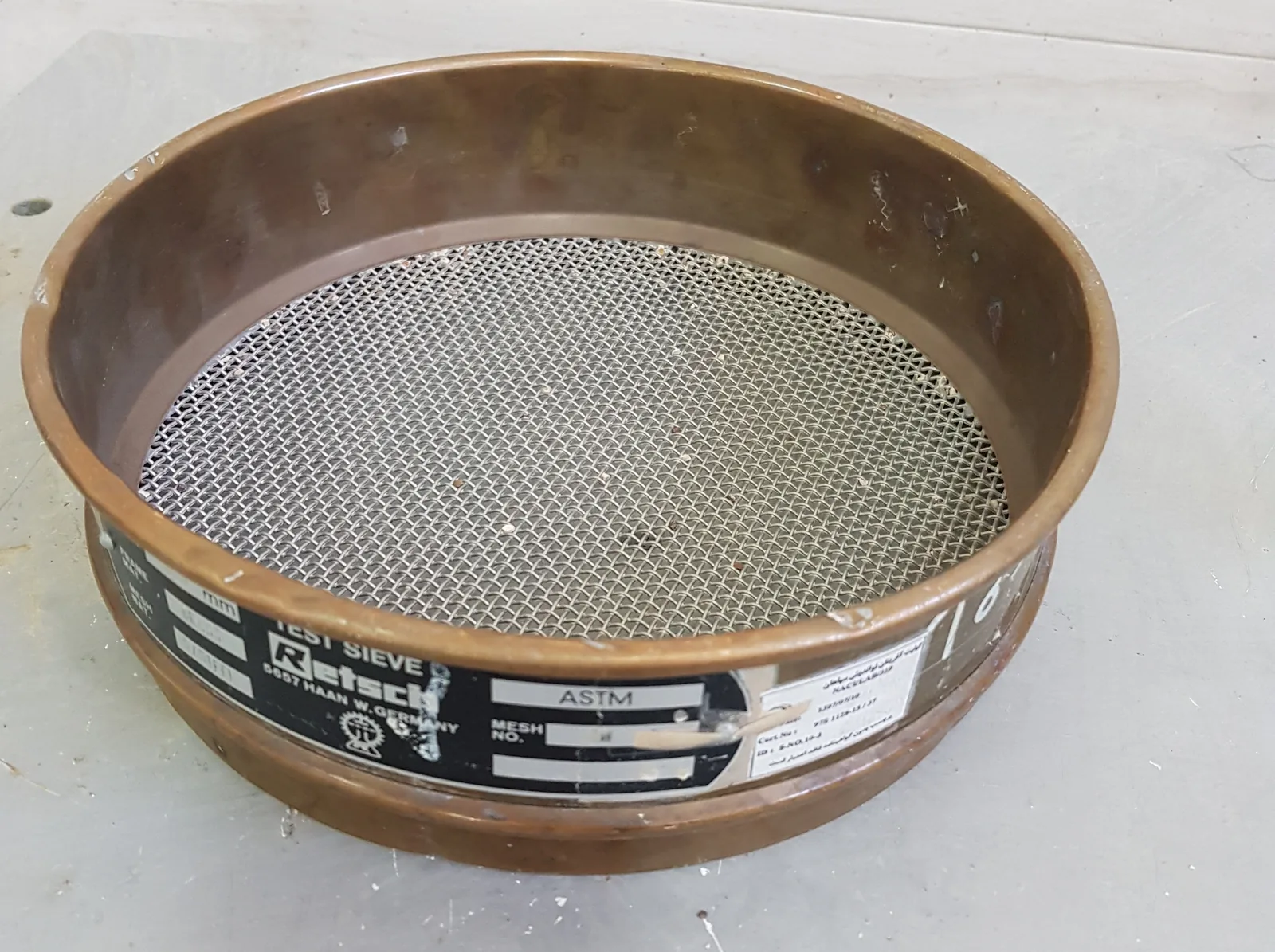
Retsch test sieve, with wire cloth in a brass frame, labeled to the American ASTM standard: the basic instrument of particle size analysisCnnresearcher · CC BY-SA 4.0, cropped
What it makes
Retsch makes no roasting machine. It builds sample preparation and particle size analysis instruments, that is, for measuring the size of grains. Three families of instruments touch green coffee. First the rotary divider. A rotating distributor splits the material among six, eight or ten outlets, so that each share has the same composition as the entire lot. Then the riffle divider, which cuts the pile in two by a series of alternating chutes, with no moving part at all. Finally the sieve shaker. An electromagnetic drive shakes the sieve stack in a three-dimensional throwing motion. The grain lands elsewhere on the cloth at each stroke, so it ends up meeting a mesh it can pass through. Nothing in this heats the coffee: the company stops exactly where the roaster begins.
The models
None of these instruments roasts, so the range is read in liters and millimeters, not kilos per batch. Rotary dividers: the PT 100 swallows up to 5,000 ml per pass. Its tray turns at 110 revolutions per minute and delivers six, eight or ten shares, in cups of 30, 100, 250 or 500 ml. The PT 200 accepts grains of 10 mm at most and gives one to three shares depending on the cone fitted. The PT 300 goes up to 30 mm grain, with a hopper of 30 or 60 liters and four to ten outlets. Riffle dividers: the RT 6.5 to RT 75 cut in two, for grains of 4 to 50 mm depending on the model. The RT 100 has an adjustable slot of 12 to 108 mm, in steps of 12. Sieve shakers: the AS 200 basic, digit cA and control cover 20 µm to 25 mm, with a digital amplitude of 0.20 to 3.00 mm. The control accepts 3 kg of load and 6 kg of sieve stack. The AS 300 control goes up to 40 mm, the AS 400 control from 45 µm to 63 mm, the AS 450 from 25 µm to 125 mm. The AS 200 jet sorts by air jet, from 10 µm to about 4 mm. Test sieves of woven wire cloth from 20 µm to 125 mm, compliant with ISO 3310-1 and ASTM E11. Perforated plate sieves from 1 to 125 mm, compliant with ISO 3310-2 and ISO 5223, in frames of 200, 305 and 400 mm.
What you gain
Everything is decided before the fire, on the sample. A PT 100 with ten outlets cuts the stream into about eleven hundred samples per minute, a figure that matches its 110 revolutions per minute. Each share thus receives a fine mix of the lot, whereas a hand plunged into a sack takes what has come up to the surface. On sizing, the AS 200 control holds its amplitude between 0.20 and 3.00 mm by digital setting. Its electromagnetic drive, patented under number EP 0642844, sets the acceleration of the stack between 1.0 and 15.1 g without going through the mains frequency. That is the detail that matters. Two instruments set alike give the same sort, in Hamburg as in Santos, whereas shaking tied to the local current would change from one country to another.
What you lose
None of this says how the bean will behave in the fire. The sieve sorts on a geometric dimension, not on density or moisture. More troublesome: ISO 3310-1 cloths are square meshes rated in millimeters, whereas the coffee trade sorts on round holes numbered in sixty-fourths of an inch. A long, flat bean passes a square mesh at an angle, not a round hole of the same size. The two scales do not transpose. Finally the PT 100 and PT 200 stop at 10 mm grain, short for large sizes.
Gray areaThe most important point first, and it puts the whole profile in question: Retsch builds no roasting machine, neither production nor sample, and nothing indicates it ever built one. It is placed here in the sample roaster family for a single reason. Its dividers and sieves serve the work surrounding the roasting of a sample, sampling and size control. It is not a roaster manufacturer and the profile must not suggest otherwise. The company does not aim at the coffee market anyway. No application note devoted to coffee, green coffee or coffee bean size was found in its knowledge base, whose list of articles was browsed. The coffee use described here is therefore a deduction, not a claim by the manufacturer. Next, the dates, which are all the manufacturer's and could not be cross-checked elsewhere. The official timeline gives 1976 for the move to Haan, and not 1959: the 1959 date could not be confirmed and was not retained. The manufacturer writes that the 1923 mortar grinder was developed, never that it was patented. This 1923 patent could not be verified, for lack of access to a registry. The founder is named Friedrich Kurt Retsch by the manufacturer, not F. Kurt Retsch. The buyout by the Verder group is dated 1989 by the manufacturer. On the other hand the country and year of founding of that group could not be verified, and are therefore not written. The link between Retsch and Endecotts could not be established, and everything indicates that it does not exist. The Verder Scientific page consulted lists six brands, Carbolite Gero, Eltra, QATM, Retsch, Microtrac and Erweka, without Endecotts, and Endecotts's site does not publish its shareholder. This lineage was therefore not taken up. The centenary press page cited at the outset returns a 404 error and could not be read. On the technical side, the page for perforated plate sieves does not say whether the holes are round or square. ISO 3310-2 compliance allows both. The exact geometry therefore remains to be verified before making them an equivalent of coffee screens. The ISO 4150 standard, which would cover particle size analysis of green coffee, could not be consulted. The iso.org site returned a 403 error, and this standard is therefore not cited. The maximum grain size of 10 mm for the PT 100 and PT 200 comes from the category page and not from the detailed sheet of each instrument, which does not repeat it. No throughput in kilos per hour is published for the dividers. The figure of about eleven hundred samples per minute is manufacturer data, consistent with the 110 revolutions per minute and the ten outlets, but it was not measured. The same goes for the acceleration of 1.0 to 15.1 g of the AS 200 control and for the announced reproducibility between two instruments. The workforce, more than one hundred and fifty people, and the installed base, more than three hundred thousand instruments, are also manufacturer figures. The general catalog in PDF format was not opened, and no company archive or independent trade press could be consulted during this work. Finally the exact address of the headquarters was not recorded beyond the city of Haan.
Manufacturer's website retsch.com, Company and About us pages, timeline 1915, 1923, 1950, 1976, 1989, 2000, 2012 and 2015, as well as the workforce of more than one hundred and fifty people and the installed base of more than three hundred thousand instruments, accessed September 2026; retsch.com, Sample dividers page and PT 100 sheet, sections Technical data and Function, for the 5,000 ml, the 110 revolutions per minute, the six, eight or ten outlets, the cups of 30 to 500 ml and the eleven hundred samples per minute, accessed September 2026; retsch.com, same page, for the grain sizes of the PT 200 and PT 300, the 30 and 60 liter hoppers, the RT 6.5 to RT 75 and the slot of the RT 100, accessed September 2026; retsch.com, Sieve shakers and AS 200 control pages, sections Technical data and Function, for the measuring ranges of the AS 200, AS 200 jet, AS 300, AS 400 and AS 450, the amplitude 0.20 to 3.00 mm, the 3 kg of load, the 6 kg of stack, the acceleration of 1.0 to 15.1 g, patent EP 0642844 and independence from the mains frequency, accessed September 2026; retsch.com, Test sieves page, for the ranges 20 µm to 125 mm in woven wire cloth and 1 to 125 mm in perforated plate, the standards ISO 3310-1, ASTM E11, ISO 3310-2 and ISO 5223, and the frames of 200, 305 and 400 mm, accessed September 2026; retsch.com, Mortar Grinder RM 200 page, Function section, for the rotating mortar, the off-center pestle driven by contact and the reduction by pressure and friction, accessed September 2026; verder-scientific.com, home page, for the composition of the Verder group's scientific division in six brands, accessed September 2026; a professional training document, for the grading of green coffee on round holes in sixty-fourths of an inch