Probat
Industry and continuous roasting, Emmerich am Rhein, Germany.
History
It all begins with a sorting machine. Alexius van Gülpen produces in Emmerich, in 1860, a green coffee grader; in 1868 he teams up with Johann Heinrich Lensing and Theodor von Gimborn to found the Emmericher Maschinenfabrik und Eisengießerei. In 1870 the company launches its spherical roaster, the Emmericher Kugelröster, heated with wood and coke.
The factory is destroyed by bombing in 1944 and rebuilt in 1949; the company takes the name Probat in 1959. Then it buys: Bauermeister in 1985, a specialist in grinding and not roasting; Hamburg Dresdner Maschinenfabriken in 2013, cocoa and chocolate; A. C. Horn and Royal Duyvis Wiener in 2024, the latter to enter cocoa; and a unified “Probat” brand in 2025. Gothot, the Mülheim competitor, was absorbed at a date that Probat publishes nowhere, not even in its press release for Gothot's 125 years. The company becomes Probat AG on September 5, 2022, then Probat SE on July 14, 2023: 198.3 million euros in revenue and about 900 employees in 2023, 80% export.
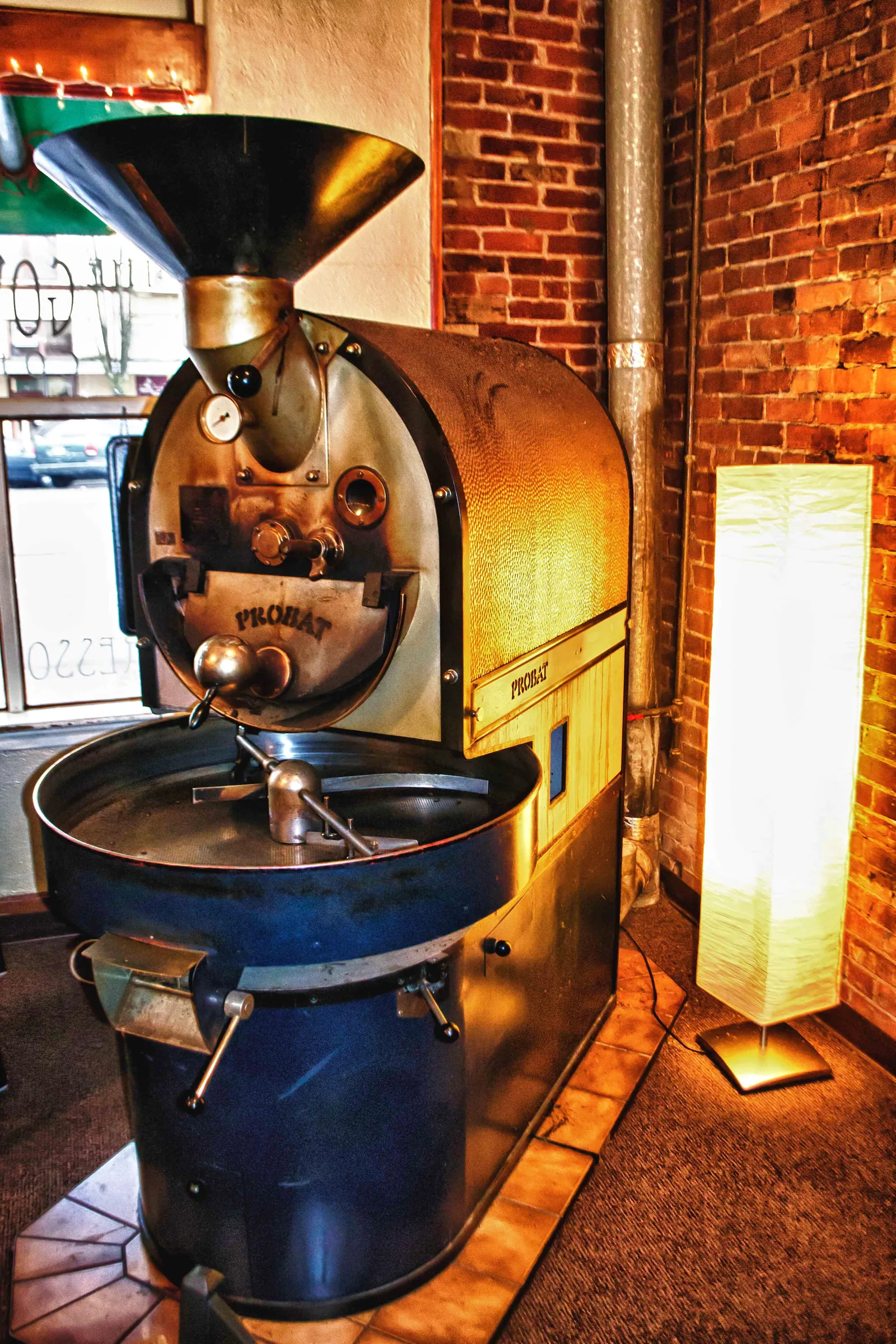
What it makes
Not one principle but four, which is the mark of a manufacturer covering the whole chain: the drum with dominant convection and indirect heating (G series, “heat is transferred primarily via convection”); the fixed chamber with tangential air stirred by paddles, with recirculation (Jupiter); the centrifugal rotating vessel (Saturn); the industrial recirculating drum (Neptune). Plus complete lines, from sack to package.
The models
Shop and artisan: P01 (0.8 to 1.2 kg, electric), P05 (1 to 6 kg), P12 (1 to 15 kg), P25 (1 to 30 kg), on gas, propane, electricity or hydrogen. Convective drums G45, G75, G120 (20 to 120 kg) and Cx70. Industry: Jupiter 500 to 5000 (up to 5,000 kg/h), Neptune 1000 to 4000, Saturn 2500 and 4000. The BRZ for samples.
What you gain
Indirect heating eliminates flame marking of the bean and decouples two settings that direct flame mixes: thermal power and airflow. It is this decoupling that makes a profile reproducible all year round, the number one requirement of an industrial roaster. Recirculation sends the cleaned exhaust back to the combustion chamber instead of throwing it away hot: the trade press puts the order of magnitude around 25%, Probat announces up to 30%. And the scale changes, from 0.8 kg to 5,000 kg/h, without changing the vocabulary of settings.
What you lose
A recirculation circuit has more inertia than an open drum: the returned air is already hot, a drop in setpoint takes effect more slowly, corrections are less nimble than on a small direct-flame machine. Compliance requires afterburning, an investment and consumption that small businesses absorb poorly. And on the P series, Probat does not publish the construction of its drums, single or double wall, nor the share of conduction: the pages remain commercial, which hampers comparison with a competitor that does publish.