Chris Hilder is a software engineer. In 2015, he wanted to roast his own coffee and found no appliance that satisfied him. He then wrote the firmware himself, the embedded program that controls the machine, and spent four years on it. This order of things sheds light on the product: the software came before the machine, and it is still the software one buys. Kaffelogic Limited was incorporated on December 22, 2017 in Dunedin, in Otago. Hilder has been a director since that day. John Robson arrived in 2018 and became a director on January 25, 2019. He comes from coffee equipment trading, a trade the engineer does not have, and it is he who opened the sales channels. The Nano 7 came out in 2019 in New Zealand and Australia. Europe followed in 2021, where the machine is sold under the name Nano 7e. The United States came in spring 2022, after a crowdfunding campaign on Indiegogo. A third director, Peter Farrell, joined on August 4, 2021. In 2023, Carlos Medina won for Chile the world champion title at the Brewers Cup, the filter coffee competition. The company says his coffee was roasted on a Nano 7. It announces more than eight thousand machines in more than twenty countries, and still manufactures in Dunedin.
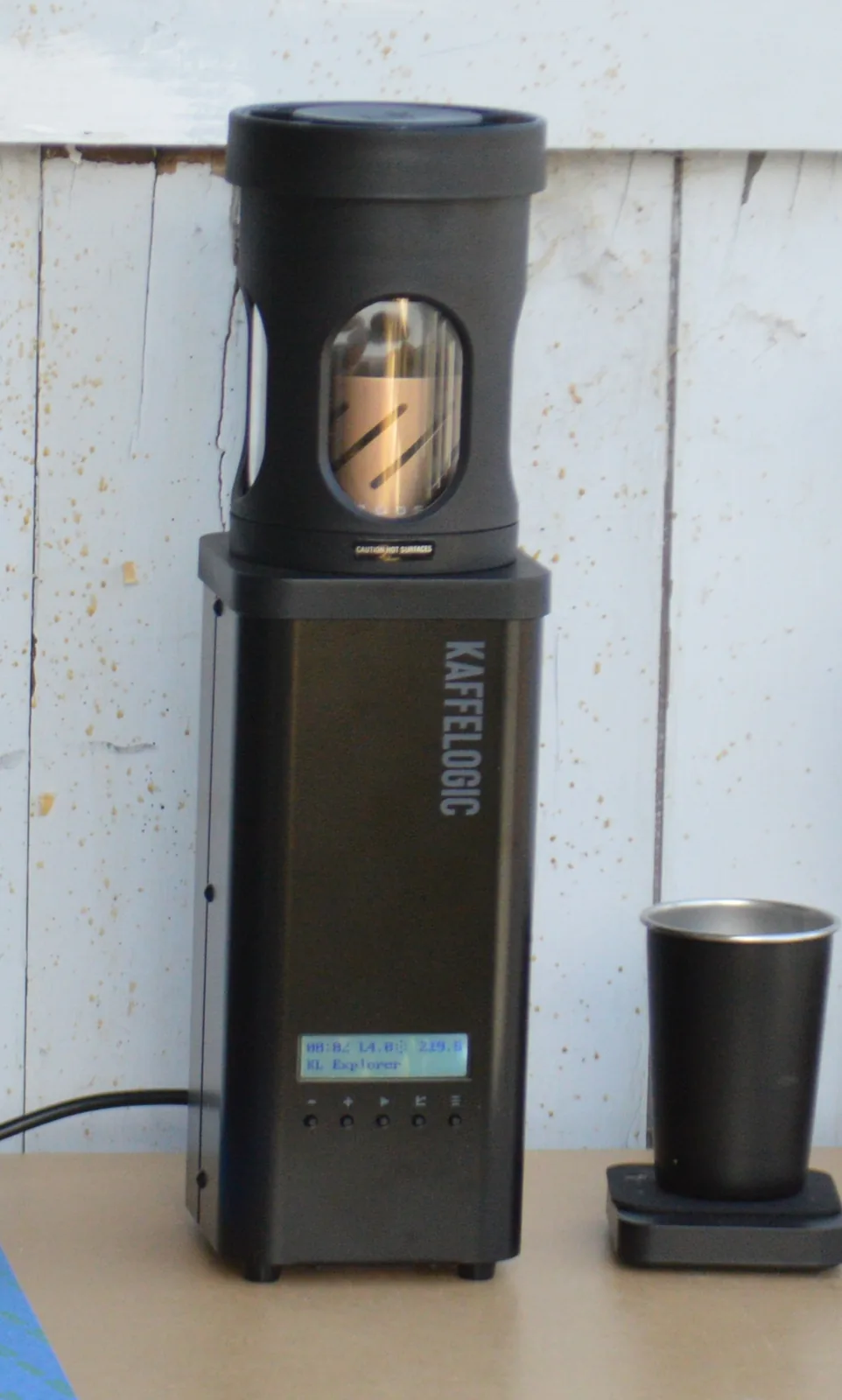
The Kaffelogic Nano 7, a hot-air sample roaster, set up outdoorsKobidin · CC BY-SA 4.0, cropped
What it makes
Kaffelogic builds only one machine, an electric fluid bed sample roaster. The principle fits in one sentence. Hot air is blown under the load hard enough to lift it and make it roll over itself. The bean then touches no hot wall: it receives only convection, never conduction. A 1,400 W heating element heats the air, a 60 W brushless motor pushes it, and the profile sets the power and air speed at every instant. The temperature is taken by a bare thermocouple, a junction of two metals whose voltage varies with heat, left exposed in the stream of beans. It is read twenty times per second. The regulation is a modified PID, a controller that compares setpoint and measurement. It works on fifteen seconds of sliding data, to calculate the rate of rise and correct before the deviation appears. Body in powder-coated steel, a paint baked in the oven, aluminum chamber, PA66 nylon fittings, 3.6 kg on the table.
The models
A single model in production, the Nano 7, sold in Europe under the name Nano 7e. Base load 120 g of green coffee, or about 100 g roasted. The BOOST kit adds two chamber extension rings, one short and one tall, plus an activation code. It opens the range of 50 to 200 g, in steps of ten grams. The machine itself scales the heat and airflow to the announced weight, which avoids retouching the profile at every change of load. Roast under ten minutes, cooling of two to three minutes. Three electrical versions: 100 V, 120 V and 220 to 240 V, at 50 or 60 Hz. Dimensions 125 x 125 x 450 mm. Duty cycle given as 120 minutes of running per two-hour period, that is, continuous running. Two-year warranty on parts. Accessories: wireless link module, chaff collector, bean tray, case. The free Kaffelogic Studio software imports and exports Artisan, Cropster and Sonofresco profiles, and imports those of Ikawa. It also converts times and temperatures for a production roaster, which is the only bridge offered to the drum. Nucleus Coffee Tools sells a sample roaster, the LINK, of 50 to 100 g, whose software is hosted on Kaffelogic's servers.
What you gain
The fluid bed removes all contact with a hot wall. The bean receives no conduction: no scorched side, no blackened tip, even at fifty grams. The bare thermocouple has almost no thermal mass. It therefore follows the bean without delay, whereas a sheathed probe lags by several seconds. Twenty readings per second and fifteen seconds of memory give the controller what it needs to anticipate the rise instead of enduring it. Nothing preheats: there is no drum to bring up to temperature, hence no wait before the first batch. The manufacturer gives one hundred twenty minutes of running per two-hour period. The manual adds that no rest is needed between two roasts, and that there is no daily limit. At 1,400 W on a household outlet, the machine goes where gas does not.
What you lose
Full convection is precisely what does not transpose. A production drum heats first by conduction on its wall. The same curve does not give the same bean there. The sample validates the green coffee, it does not validate the production profile. A single probe here, where a Roest L100 Plus carries five: bean mass, air inlet, outlet, drum and ambient. Its bare tip breaks if a stuck bean is pulled off, and the manual asks to crush it with pliers. First crack is entered by hand by the operator, the machine does not detect it. The chaff collector must be emptied before every batch, on pain of fire risk, and nothing on the machine reminds you. Cap at 200 g, non-detachable 107 cm cord, automatic stop if the load circulates poorly.
Gray areaThe year retained is that of the incorporation, December 22, 2017. The company nevertheless traces the adventure back to 2015, the year Chris Hilder began looking for his machine. Nothing says what existed between the two dates, or in what legal form. The four years of firmware development are bounded by no precise date. What the “e” of Nano 7e stands for is explained nowhere, and the site now publishes only a single product sheet. The site today lists resellers in the United Kingdom and China. The year these two markets opened could not be established, for lack of a source found. The base load is given as 120 g on the product sheet, but as 100 g in the 2022 press. The upper limit of the BOOST kit is 200 g on the product sheet and “180 to 200 g” in the manual. The nature of the probe is debated. The company describes it as planted in the mass of beans, the consulting roaster Christopher Feran speaks of an outlet air probe. In a fluid bed the two places partly merge, and no dimensioned diagram settles it. The hourly throughput is not published by the company. A British reseller speaks of about 700 g of green per hour, on the word of users, with no independent measurement. Degassing and rest time could not be documented by any reliable source. The only observation found goes the other way, a better cup stability over three or four days than that of a competitor. The audibility of first crack in the fan's blast is established nowhere. No patent search could succeed. Google Patents refused automated requests. No filing in the name of Kaffelogic or Christopher Hilder was therefore found or ruled out. The hardware link with the Nucleus LINK is established by no statement from either company. What can be verified is that the LINK software is downloaded from webservices.kaffelogic.com. The eight thousand machines and the twenty countries come from the company alone, without outside verification. The title of Carlos Medina is real: World Brewers Cup champion 2023, for Chile. That his coffee was roasted only on a Nano 7 rests solely on the manufacturer's Pro roasting page. The exact type of thermocouple, the frequency of the power loop and the power actually available per gram at a 200 g load are published nowhere. Finally, the mention “designed and made in New Zealand” does not say what share of the components is made in Dunedin.
Manufacturer's website kaffelogic.com, Our team page, research begun by Chris Hilder in 2015, registration in New Zealand in 2017, arrival of John Robson in 2018, more than eight thousand machines in more than twenty countries, accessed in September 2026; kaffelogic.com, Nano 7 product sheet, Specifications section, 120 g base and 50 to 200 g with BOOST, 1,400 W, 60 W direct-current brushless motor, 100 V / 120 V / 220-240 V at 50-60 Hz, 125 x 125 x 450 mm, 3.6 kg, aluminum chamber, powder-coated steel body, PA66 nylon fittings, roast under ten minutes, cooling of two to three minutes, two-year warranty on parts; kaffelogic.com, BOOST page, two extension rings (one short, one tall), activation code, 50 to 200 g in steps of ten grams, automatic scaling of heat and fan; kaffelogic.com, Studio page, Artisan, Cropster and Sonofresco import and export, Ikawa import, conversion of times and temperatures for a production roaster; kaffelogic.com, Pro roasting page, Carlos Medina presented as the first World Brewers Cup champion on a Nano 7; kaffelogic.com, Distributors page, resellers in about twenty countries including the United Kingdom and China, accessed in September 2026; Kaffelogic, KL User Manual V3.12, Safety section, duty cycle of 120 minutes per two-hour period and mention “designed for continuous use,” Support section, headings Back to back roasting (no rest between batches, no daily limit other than the twenty-four hours of the day), Thermal dip/runaway (stop in case of poor bean circulation) and Bean stuck to the temperature probe (crush the bean with pliers, do not pull on pain of breaking the tip), Care section (do not touch the bare tip), settings DEV% LOCK and ENTERED FC/END, which show that first crack is entered by the operator, default load of 120 g and BOOST range given as “50g and 180-200g”; New Zealand Companies Register, Companies Office, Kaffelogic Limited, number 6627433, NZBN 9429046530165, incorporated on December 22, 2017, registered office 58 Glasgow Street, South Dunedin, Dunedin 9012, directors Christopher James Hilder since December 22, 2017, John Edward Francis Robson since January 25, 2019 and Peter Robert Michael Farrell since August 4, 2021, five shareholders, activity classified as household appliance manufacturing, accessed in September 2026; Daily Coffee News, “Kaffelogic Readies Spring US Launch of the Nano 7 Roaster,” February 16, 2022, four years of firmware development, 2019 launch in New Zealand and Australia, 2021 in Europe, spring 2022 in the United States after an Indiegogo campaign, bare thermocouple in the mass of beans read twenty times per second, fifteen seconds of data to calculate the rate of rise, modified PID, twelve preloaded profiles; Christopher Feran, “Sampling sample roasters,” September 1, 2023, time-temperature curve imposed on all coffees, Engineer mode of the software with wattage and PID setting, 42-inch cord, or 107 cm, non-detachable, chaff collector to empty before every batch on pain of fire risk, a single bare probe against five on the Roest L100 Plus, better cup stability over three or four days than the Ikawa; Wikipedia, World Brewers Cup, honor roll, Carlos Medina 2023 world champion for Chile; Green Coffee Collective, British distributor, Nano 7e product sheet, about 700 g of green per hour reported by users, cooling of two to four minutes, profile not transposable as is to a drum, accessed in September 2026; Nucleus Coffee Tools, LINK product page, batches of 50 to 100 g, LINK Studio software downloaded from webservices.kaffelogic.com, accessed in September 2026