Gothot
Industry and continuous roasting, Mülheim an der Ruhr, Germany.
History
Ferdinand Gothot (1856-1926), a colonial goods merchant and roaster in Mülheim, decided in 1880 to make his machines himself. A patent of 1897 covers a rotating drum; the one of 1899 founds the Ideal-Rapid line, “the basis of all the Gothot drums that will follow.” His son Heinrich (1889-1963) took over management in 1927 and laid the foundations of automation in the 1950s. Ukers cites the company in 1922 for the coke- or gas-fired Ideal-Rapid and its manual version, the Favour.
In 1969, the Rapido-Nova patent changes the principle: a machine without a rotating drum, where the bean is stirred by paddles in a closed chamber crossed by hot air, up to 4,000 kg per hour. Sixty kilometers farther on, Probat was twelve years ahead and had the same clientele. Probat's press release for Gothot's 125th anniversary, in 2005, says it without detour: “since Gothot still wanted to hold its own against Probat, its workers kept building better, bigger and more modern machines.” This race ended with a sale of shares “to the competition, in Emmerich.” When? The press release does not say.
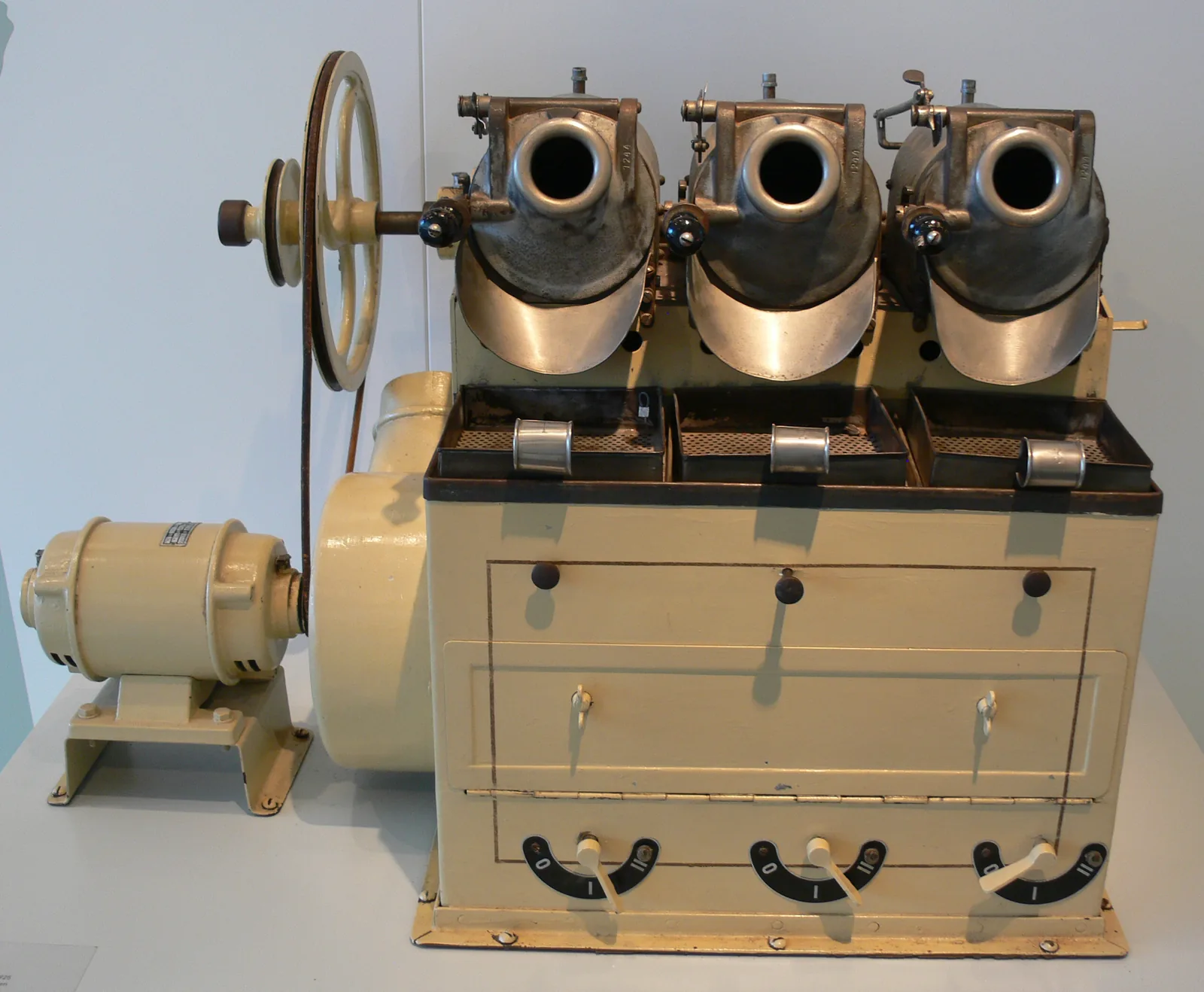
What it makes
Historically, fast drums, then the fixed paddle chamber of the Rapido-Nova. No range of its own today.
The models
Ideal-Rapid (from 1899, about 1,200 kg/h), Rapido (about 3,000 kg/h), Rapido-Nova (1969, about 4,000 kg/h). Machines of 25 to 120 kg per batch are still around on the used market; Schwartzberg cites a Rapido Nova with a thermal afterburner consuming 2,680 kJ per kilo.
What you gain
A fixed chamber stirred by paddles and crossed by hot air removes the hot rotating wall, hence bean marking, while allowing very high throughputs for the time. It was exactly the industry's need: shortening the roast without scorching the surface.
What you lose
Moving parts in the hot zone, hence wear and maintenance, where a fluid bed has none; and an industrial machine by construction, which does not come down to the artisan's scale. The company spent a century chasing a neighbor.