Fritsch was born in 1920 in Idar-Oberstein, the German city of gemstones. In its early days it was not an instrument maker but a technical trader in stones. It sold agate mortars to pharmacists and chemistry laboratories. These are bowls cut from a very hard stone, in which a material is reduced to powder by hand. The whole trade of the company is already there: reducing and dividing, never heating. In 1955 it ranked among the specialists of the application laboratory. This is the workshop where the sample is prepared and its grains are measured, before the analysis proper. This shift took it from the stone trade to building instruments. In 1962 it brought out its first planetary mill of its own design, which it says was patented. In 1973 it built its first workshop, Industriestrasse 8, to bring manufacturing and quality control together in one place. It is the address it still occupies. In 1985 it entered the laser field with the Analysette 22 particle size analyzer. It uses an optical arrangement called Reverse Fourier, of which it calls itself the inventor. The lens is placed before the sample cell, so the sample is crossed by a converging beam instead of a parallel beam. The company claims to have kept it on all its particle size analyzers since. It opened its first foreign office in Singapore in 2005, then in Russia, China, the United States and France. In 2007 it pushed grinding down to the nanometer with the Pulverisette 7 premium line. In 2012 it developed the Analysette 28 image analyzer. In 2014 it built a workshop of 4,900 square meters, to gather all its manufacturing on a single site. It celebrated its one hundredth anniversary in 2020, still in the hands of the family, with Sebastian and Maximilian Fritsch at its head. It then had 115 employees at headquarters and 15 in its sales offices, for about 20 million euros in revenue. In 2022 it opened an on-site technology center of 240 square meters. It signs as FRITSCH GmbH, Milling and Sizing.
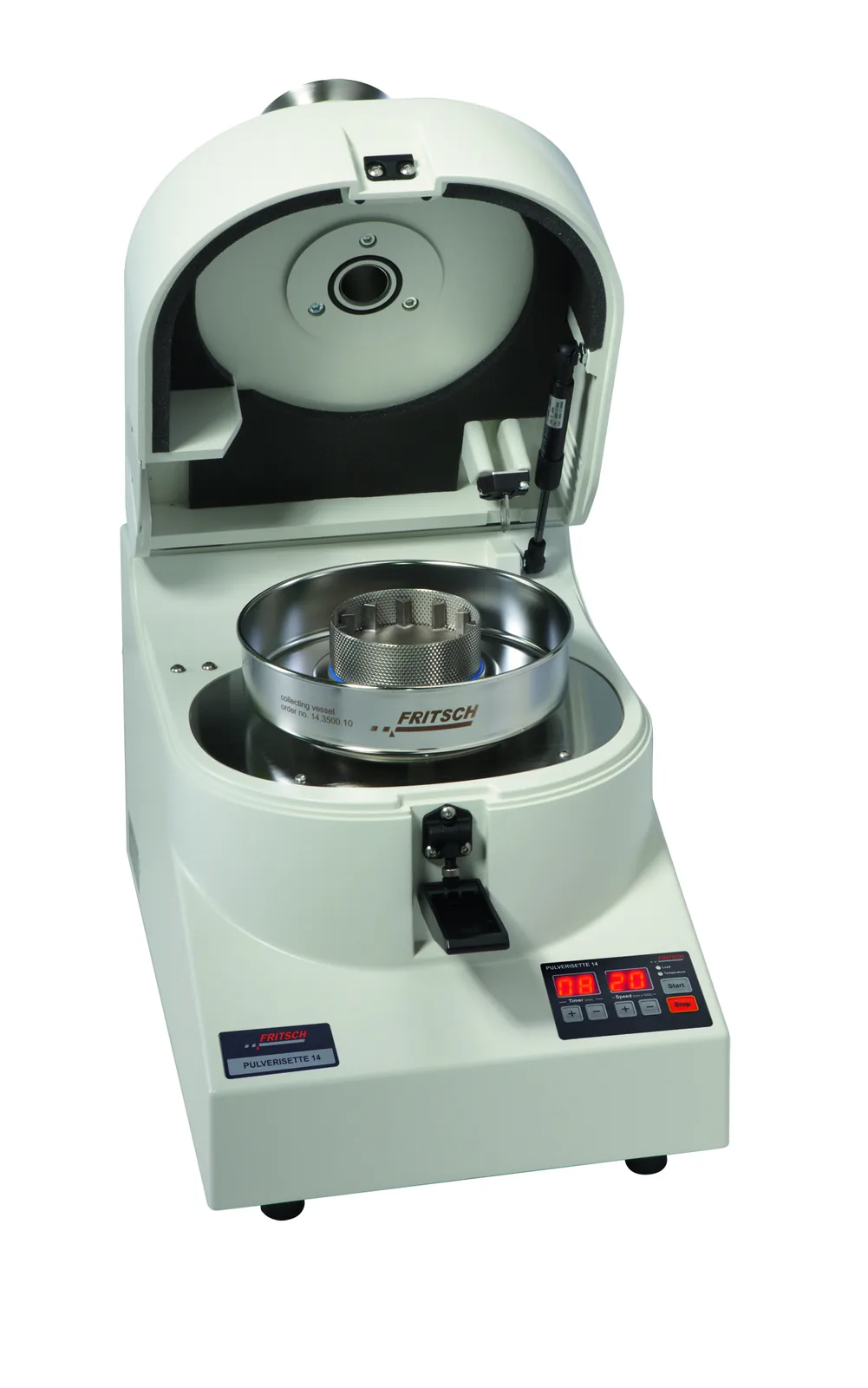
Fritsch Pulverisette 14 centrifugal mill, lid open on the grinding chamber, where a rotor throws the material against a ring sieveFight&Bite · CC BY-SA 4.0
What it makes
Fritsch builds no roasting machine, and nothing indicates it ever built one. It makes laboratory instruments that prepare the sample before analysis, and that then measure the size of its grains. It makes them itself, in its Idar-Oberstein workshop: it is neither a distributor nor an assembler. Its most useful device for coffee is the Laborette 27 rotary cone divider. A funnel drops the material onto the top of a rotating cone. The rotation throws the stream outward along the cone and distributes it into eight, ten or thirty channels depending on the head fitted. The division therefore happens over time, by successive samplings of a moving stream. It does not happen by gravity, in a motionless pile, as with the riffle divider. The latter is a device with alternating chutes, which simply cuts the pile in two. The company also builds mills, sieve shakers, vibratory feeders and laser particle size analyzers. None of this heats the coffee.
The models
Nothing here roasts, so the range is counted in milliliters and millimeters, never in kilos per batch. Laborette 27 rotary cone divider, reference 27.1600.00. Up to 3,000 division steps per minute, adjustable speed from 80 to 120 revolutions per minute. Division accuracy stated up to 99.9%, seven division heads to choose from. Head 1:8, grain of 10 mm at most, 4,000 ml per pass, bottles of 500, 250 and 32 ml. Head 1:10, grain of 10 mm, 2,500 ml, bottles of 250 and 32 ml. Head 1:30, grain of 2.5 mm only, 300 ml, bottles of 15, 20 and 30 ml. Heads in POM plastic, in anodized aluminum for abrasive materials, in PTFE-coated aluminum for the 1:30 head and aggressive materials. 10 mm funnel supplied as standard, 5 mm added with the 1:30 head, 15 and 22 mm funnels optional. Cast aluminum housing, removable head, food-grade materials, timer and RS232 link. Laborette 24 vibratory feeders: V-channel, reference 24.0030.00, from 1 to 1,500 g per minute; U-channel, reference 24.0020.00, from 5 to 2,500 g per minute. On the grinding side, the manufacturer itself documents two devices on roasted coffee. The Pulverisette 11 knife mill, reference 11.3020.00, runs at 2,000 to 10,000 revolutions per minute. It takes in a 40 mm grain and grinds finer than 300 micrometers. The Pulverisette 14 classic line rotor mill, reference 14.5020.00, runs at 6,000 to 20,000 revolutions per minute. It drives the material against a sieve ring chosen between 0.08 and 6 mm, and accepts only a 10 mm feed grain. On the measurement side, the Analysette 22 laser particle size analyzers. The NeXT Micro version, reference 22.9000.00, covers 0.5 to 1,500 micrometers. Finally the Analysette 28 image analyzer, which also gives the shape of the particles and not only their size.
What you gain
The cone does not split a pile, it cuts a stream over time. With thirty channels and 3,000 steps per minute, each bottle receives about a hundred samplings per minute. That amounts to a hundred revolutions per minute, in the middle of the 80 to 120 range. A heavy grain therefore has no time to roll to the bottom of the pile and escape the sampling. That is the whole point with a coffee lot, where heavy beans and light beans are not equal in the cup. The other gain is arithmetic. A riffle divider cuts in two: it takes five passes to get down to one thirty-second, hence five handlings and five losses. The Laborette 27 goes down to one thirtieth in a single pass.
What you lose
The head that divides most finely, 1:30, accepts only 2.5 mm grain and 300 ml. Whole coffee never passes through it, neither green nor roasted: it must be ground first, thus giving up dividing the lot as it is. That leaves the 1:8 and 1:10 heads, limited to 10 mm, the diameter of the standard funnel. A large grain then passes through an opening of its own size. It ends up bridging, that is, forming above the opening an arch of grains jammed against one another, which stops the flow. Above all, the machine faithfully reproduces what it is given. A sample badly taken at the start comes out thirty times over, at 99.9% accuracy.
Gray areaThe most important point first, as with Retsch: Fritsch builds no roasting machine, of any size. It is placed here in the family of sample roasters for a single reason. Its devices serve the work that surrounds the roasting of a sample, the division of the sampling and the control of the grind. It is not a roaster manufacturer and the profile must not suggest otherwise. The difference with Retsch comes down to a verified detail: Fritsch, for its part, does document coffee. Its database of grinding reports offers two entries, coffee beans and roasted coffee beans, but the two reports that display actually concern roasted coffee. No report on green coffee was found, and no application note devoted to green coffee either. The use on green coffee described here is therefore a deduction, not a claim by the manufacturer. The manufacturer itself warns that these reports are only indicative, since residual moisture, fat content and morphology vary from one lot to another. The list of materials and this warning were reviewed in September 2026; the two reports themselves could not be reopened on that occasion, for lack of direct access to their page. A discrepancy remains on the bowl of the Pulverisette 11: the report gives it as Tritan, the current product page gives it as polycarbonate, for the same volume of 1.4 liters. The term plastic bowl was therefore preferred over both. Then, on history. The founder's name is published nowhere. The company calls itself a family firm and names Sebastian and Maximilian Fritsch at its head from 2020. The September 2026 legal notice names only one managing director, Maximilian Fritsch. It never names the one of 1920. The fourth generation is asserted by the manufacturer's catalog, and by it alone: no independent source establishes it, and the profile therefore does not carry it into its history. The founding year, 1920, is manufacturer data, consistent across three distinct documents. The legal notice does give a register number, HRB 10148 at the Bad Kreuznach court. This register was not consulted, and a register entry in any case does not give the founding date. The 1962 planetary mill patent is asserted by the company, never referenced: no number could be found, for lack of access to a patent register. The invention of the Reverse Fourier optics is likewise claimed by the company alone, with no patent or publication produced in support. Beware, finally, of a namesake that causes confusion. There is another German company named Fritsch, based in Markt Einersheim. It makes bakery machines and has nothing to do with this one. On the technical side. The table of the Laborette 27 heads, head by head, comes from the PDF catalog alone: the online product page publishes only the overall values, 4,000 ml at most and bottles of 5 to 500 ml, which do agree. The ratio of 3,000 steps per minute to 80 to 120 revolutions is an arithmetic deduction, thirty channels at a hundred revolutions. It is not a figure published as such. The actual throughput in grams per minute of a Laborette 27 is published nowhere. The maximum volume of 4,000 ml was not converted into kilos of coffee, for lack of a verified bulk density for loose green coffee. Report M002198 leaves empty the input and output fineness boxes of its first trial. Report M200082 leaves its final fineness box at a truncated word. The figures retained therefore come from the columns of the research table and the operator's comments. The price of the devices is published nowhere. The application knowledge base page and the iso.org site returned errors, so no green coffee sampling standard is cited here. Finally, no company archive or independent trade press could be consulted during this work: all the material comes from the manufacturer.
Manufacturer's website fritsch-international.com, About page, History section, for the milestones of 1920, 1955, 1962, 1973, 1985, 2005, 2007, 2012, 2014, 2020 and 2022, as well as for the 4,900 square meters of 2014, the 115 employees at headquarters, the 15 employees of the sales offices, the 20 million euros in revenue and the 240 square meters of the 2022 technology center, accessed in September 2026; fritsch-international.com, Profile page, for the company name FRITSCH GmbH Milling and Sizing and the address Industriestrasse 8, 55743 Idar-Oberstein, accessed in September 2026; fritsch-international.com, legal notice, for Maximilian Fritsch managing director, the commercial register of the Bad Kreuznach court under HRB 10148 and the VAT number DE811189307, accessed in September 2026; catalog Product Overview Sample Preparation, English PDF, page 3 for the fourth generation, the subsidiaries and the two employees in France, pages 5 and 6 for the targeted analytical fineness of 20 micrometers to 2 mm and the grinding principles, pages 26 and 27 for the table of Laborette 27 heads, page 28 for the Laborette 24; fritsch-international.com, Laborette 27 product page, sections Overview, Operating Principle, Features and Equipment, for the reference 27.1600.00, the 3,000 steps per minute, the 80 to 120 revolutions per minute, the 99.9%, the seven heads at ratios 1:8, 1:10 and 1:30, the POM, anodized aluminum and PTFE-coated aluminum materials, the 5, 10, 15 and 22 mm funnels, the 4,000 ml, the bottles of 5 to 500 ml, the cast aluminum housing, the food-grade materials and the RS232 link, accessed in September 2026; fritsch-international.com, Laborette 24 product pages with V-channel and U-channel, for the references 24.0030.00 and 24.0020.00 and the throughputs of 1 to 1,500 and 5 to 2,500 g per minute, accessed in September 2026; fritsch-international.com, Pulverisette 11 product page, for the reference 11.3020.00, the 2,000 to 10,000 revolutions per minute, the 40 mm feed grain, the fineness below 300 micrometers and the 1.4 liter bowl, accessed in September 2026; fritsch-international.com, Pulverisette 14 classic line product page, for the reference 14.5020.00, the 6,000 to 20,000 revolutions per minute, the sieve rings of 0.08 to 6 mm, the 10 mm feed grain and the principle of impact then shear, accessed in September 2026; the manufacturer's grinding reports database, search page, for the two entries coffee beans and roasted coffee beans and for the manufacturer's warning on the merely indicative value of the results, accessed in September 2026; same database, report M200082, roasted coffee, Pulverisette 11 knife mill, 1.4 L plastic bowl, standard stainless steel knife, 140 g, feed grain 8 mm, speed reduced to 5,000 revolutions per minute, 2 minutes, fineness obtained 100% below 2 mm; same database, report M002198, roasted coffee, Pulverisette 14 classic line rotor mill at 20,000 revolutions per minute, twelve-rib rotor, 2 mm sieve ring for 50 g in 30 seconds, 0.5 mm ring for 30 g in 50 seconds, 0.2 mm trial abandoned because of clogging; fritsch-international.com, Analysette 22 NeXT Micro page, for the reference 22.9000.00, the range 0.5 to 1,500 micrometers and the Reverse Fourier design claimed by the manufacturer on all its particle size analyzers, accessed in September 2026