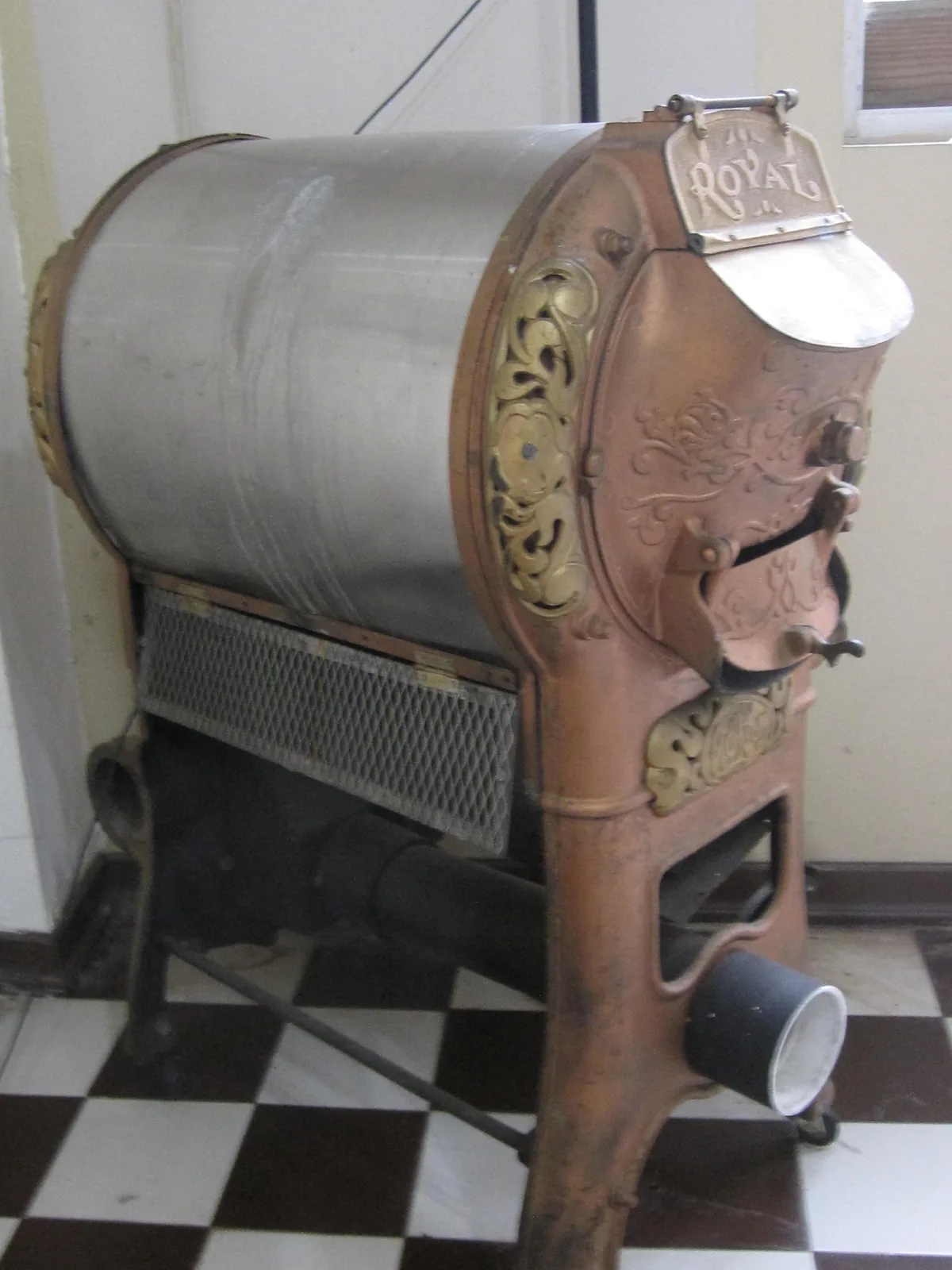
A. J. Deer Co. (Royal range)
Production drums, Buffalo then Hornell, New York State, United States.
History
The firm was born of the grinder, not of the roaster. In 1905, in Buffalo, it sold its Royal electric grinders directly to retailers, on installment, that is, payable in staggered drafts. Until then, a shop grinder went through a hardware wholesaler. Ukers wrote in 1922 that this direct selling overturned the practice. The reason is simple. The grocer who could not pay cash was finally able to equip himself. This commercial choice left its trace in the organization chart. Levi G. Robbins spent fifteen years with the firm as advertising manager, head of collections, then sales director and vice president. A firm that sells on credit needs someone to collect the drafts. It did not invent its roaster, it bought it. Joseph C. Prims, of Battle Creek in Michigan, patented in 1908 a fluted cylinder which he assigned to his own J. C. Prims Machinery Company. A. J. Deer took over the machine in 1909 and relaunched it under the name Royal. Prims then settled in Hornell, where the firm was established by March 1910 at the latest. He went on patenting for it there, from the 1915 improvement to the slicing machines of the twenties. The workshop did not live on coffee alone. Four slicing-machine patents were issued to it between January 1922 and January 1923, signed by three different men. The firm also made advertising films, and Ukers ranks it among the first in coffee to have taken them up. It did not survive the Great Depression. In 1935, a biographical compendium of Steuben County presents the Royal Electric Fixture Corporation as the successor of the A. J. Deer Co. Robbins was then its president.
What it makes
Shop roasters with a horizontal drum, heated by gas or charcoal, intended for the retailer who roasts for himself. The 1908 Prims patent describes a cylinder made of sheet metal, not cast iron. Its flutes, that is, its hollow-and-raised undulations, are arranged in a spiral. Conveying paddles are fixed in overlapping series along their ridges. Other paddles, also in a spiral, are mounted inside the first ones. This geometry does not merely turn the bean over. It pushes it along the cylinder. The bean therefore circulates instead of sliding in a layer against the same sheet. The second patent, obtained in 1915 and assigned to the firm, does not touch the drum. It concerns the air. A single turbine serves three ducts, and a rotary valve connects only one at a time while closing the others. On a countertop unit, space and price allow only one fan. Ukers also writes that in 1922 retail machines cool by suction, in a bin attached to the roaster. The firm did not live on the roaster alone. It built in the same workshop electric grinders and slicing machines, all sold under the Royal brand. It also supplied peanut roasters. A specimen listed in an antiques guide bears the mark of the Planter's Nut and Chocolate Company. It has a copper drum on a cast-iron frame.
The models
The period specification is found in Ukers. The Prims patent targets there a retail machine of 50 to 130 pounds, or 23 to 59 kg. Ukers elsewhere places the retail roasters of his time between 10 and 300 pounds, or 4.5 to 136 kg. They sold for 300 to 1,500 dollars depending on size. He counts eight cents of gas per hundred pounds roasted, and ten cents if the motive power is electric. A batch took about half an hour. The Royal range itself is numbered, and nothing of it has been built since the firm disappeared. The capacities below come from restored machines put back on sale by an American broker, not from a period catalog. Royal No. 1: about 4.5 kg per batch, or 10 pounds, ornate cast iron, given for coffee as well as for peanuts. Royal No. 4: about 7 kg, or 15 pounds, specimens dated by the seller to around 1911 to 1914. Royal No. 5: about 9 kg, or 20 pounds. Royal No. 6: about 30 kg, or 66 pounds. These four figures do not match the 50 to 130 pounds of the patent. See the gray area. In September 2026, this same broker was asking 10,000 to 15,000 dollars for a restored Royal.
What you gain
Heating is direct: the flame works under the drum, with no intermediate exchanger to cushion the fire. The response is therefore immediate, and a rise can be corrected in a few seconds. Ukers describes the corresponding gesture. When the bean starts to crackle, the flame is lowered so that the heat reaches the heart of the bean without burning the surface. At the very end, it is almost put out. The spiral flutes and their paddles push the charge along the cylinder. No face of the bean therefore stays pressed against the same point of hot sheet metal. The single turbine and its rotary valve avoid installing a fan for each function. This is what makes it possible to hold several operations in a single countertop frame. The mechanics remain simple, which is why these machines are running again a century later, once fitted with modern gas valves and a probe linked to Cropster or Artisan.
What you lose
The bare flame burns the surface of the bean if the charge is too small or the rise too sharp. Nothing recycles the air. In 1922 Ukers set out this discharge as the real limit on shop roasting. Steam, smoke and chaff must go outside without disturbing the neighborhood or creating a fire risk. This is what then kept the retailer from equipping himself with a roaster as easily as with a grinder or a slicer. A modern urban regulation accepts it even less, for lack of an afterburner, that is, a second burner that burns the fumes again. Operation is entirely manual. There is no temperature probe. The operator draws a sample with the trier, the hollow spoon that brings a few beans out of the drum, and compares the color to a standard sample. This is exactly why restorers graft on a PID controller. A batch taking about half an hour, throughput remains low. Finally, the manufacturer died in the thirties. No original spare parts, no technical service, and the broker himself points out that no manual comes with the machines he sells.