Sampling and measurement, Mentor, Ohio, United States (Cleveland from 1872 to 1994).
WhereMentor, Ohio, United States (Cleveland from 1872 to 1994)
Since1872
FamilySampling and measurement
History
Washington Samuel Tyler was born in 1835 in Ohio City, a town on the west bank of the Cuyahoga annexed to Cleveland in 1854. In 1872, he opened the Cleveland Wire Works with eleven workmen. The company then sold ornamental goods: woven wire screens, chimney fire screens, garden trellises, elevator cab enclosures. In 1878, Tyler installed power looms and began crimping wire in stages. Crimping locks the wires at their crossing, so the opening stops moving. This is what would make the sieve measurable. The shop became the W. S. Tyler Company in September 1889. In 1910, Tyler published a series of test sieves built by calculation, and not by shop habit. It would be adopted as the basis of the ASTM E-11 standard. That is the whole point: before it, two laboratories sieving the same product could not compare their results. In 1914, the company launched the Ro-Tap shaker and moved to Superior Avenue, on a million square feet. Tyler died in 1917, the year his first fully mechanical vibrating screen came out. The company absorbed the Standard Company in 1918. It worked with the German Haver & Boecker from 1930, then set up with it the Tylinter joint venture at the end of the 1950s. The Cleveland headquarters closed in 1970. The elevator division left for Twinsburg in 1984, the screening division for Mentor in 1994. The two trades then separated for good. Haver & Boecker, a German weaver founded in 1887, bought the screening business in 1998: thirty years of joint work had prepared the ground. In 2026, the company took the name Haver & Boecker Wire Weaving Inc. The W. S. Tyler name now designates only the particle size analysis line, that is, the measurement of particle size.
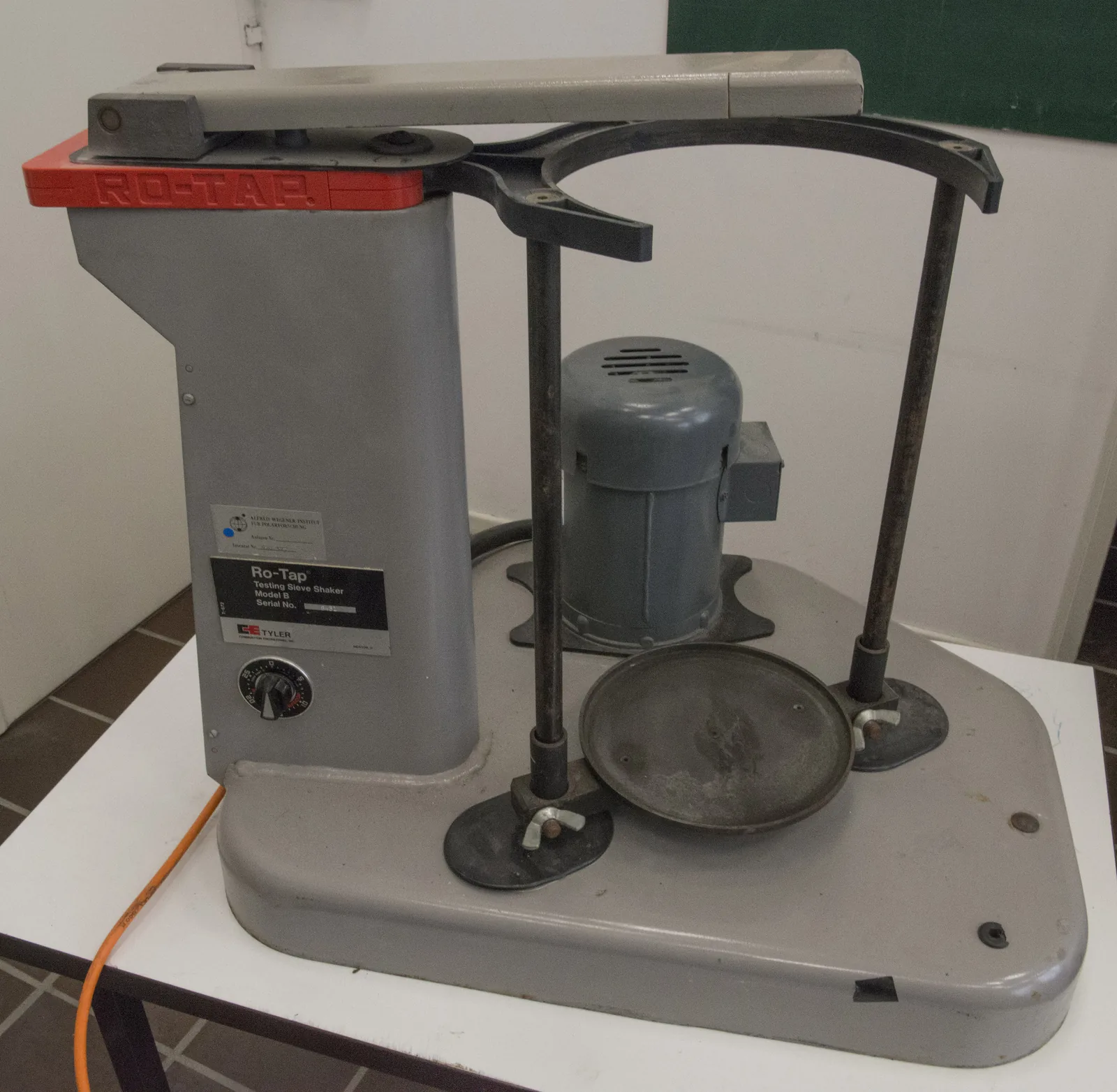
W. S. Tyler Ro-Tap laboratory sieve shaker, model B, from the 1980s: the plate carries the company name; the stack of sieves sits on the tray, under the armHannes Grobe · CC BY 3.0
What it makes
W. S. Tyler builds no roaster. The company weaves wire cloth, mounts it into test sieves and makes the machines that shake those sieves. The basic principle is the plain weave: warp and weft wires crossed at right angles, leaving a square opening. For coarse meshes, the wires are crimped before weaving, that is, corrugated in advance, so that they lock at each crossing. The opening then no longer moves under load. That is the whole value of a sieve: a mesh that deforms no longer measures anything. The catalog names these weaves Lock Crimp type D, Double Intermediate Crimp type C and Flat Top type E. The sieves are mounted on brass or stainless steel frames and woven to ASTM E-11 and ISO 3310-1 standards. No perforated plate with round holes appears in the catalog. The shakers follow two opposite principles. The mechanical Ro-Taps combine a horizontal rotation and the vertical strike of a hammer. The electromagnetic Ro-Taps replace the hammer with micro-vibrations, which draw an elliptical movement in three dimensions. The second principle is gentler and quieter, but it does not reach as far into the coarse range.
The models
Nothing here is counted in kilos per batch. Capacity is measured in stacked sieves and grams of sample. Test sieves in diameters of 3, 8 and 12 inches plus 200 and 300 mm in the standard catalog, 6, 10 and 18 inches as custom sizes. Numbers 3 1/2 to 635. The standard sieves cover from five inches of opening to number 635. Only precision sonic sieves go down to three micrometers. Variants: standard sieves, custom sieves, tall-frame wet-wash sieves, air-jet sieves, three-inch sonic sieves in clear acrylic. Four mechanical Ro-Tap shakers. Three of them run at 278 oscillations and 150 taps per minute, within ten. The RX-29 takes eight-inch sieves: six full-height or thirteen half-height, from four inches to mesh 635, or twenty micrometers. The RX-30 does the same in twelve inches, with four full-height sieves or six half-height. The RX-812 aims at the coarse: oscillation only, no tapping, 280 strokes per minute at 60 Hz and 231 at 50 Hz, mesh 80 and beyond. The RX-94 Duo stays at eight inches and goes down from two inches to mesh 635. Power supply 115 or 230 V, at 50 or 60 Hz. Electromagnetic shakers in eight inches: E Pure, E Premium and E Premium Remote. Only the E Premium has an amplitude adjustable up to three millimeters. The other two offer only a fine or coarse setting. All three cover only twenty to one hundred twenty-five micrometers. Added to these are the fixed-frequency sonic sifter, the VariSifter adjustable from 15 to 60 Hz, the NEXOPART e200 LS air-jet sieve shaker and a dynamic image analyzer.
What you gain
A sieve gives a number, not an impression. On ground coffee, the RX-29 adds 278 horizontal oscillations and 150 vertical taps per minute. The tapping breaks the agglomerates that the oil of a fresh grind glues back together, and that mere rotation would count as large particles. Both rates are fixed: the same grind, run twice, gives the same curve. The manufacturer publishes a standard stack for coffee, numbers 40 to 70. That makes 425 to 212 micrometers of opening according to ASTM E-11, with a number 200 added when the grind carries many fines. The cloths are woven under ASTM E-11 and can be certified piece by piece. Two laboratories then measure the same thing, which no grinder setting guarantees by itself.
What you lose
The tapping is brutal and noisy. The soundproof enclosure sold as an accessory brings the level down from 85 to 78 decibels, which says enough about the starting noise. The electromagnetic Ro-Taps are quieter, but they stop at one hundred twenty-five micrometers. Yet the stack the manufacturer recommends for coffee starts at two hundred twelve micrometers. They are therefore of no use here, and one has to go back to the mechanical. Sieving classifies a particle by its smallest cross-section, never by its volume: an elongated fragment passes by its width and ends up counted as fine. Oily coffee agglomerates and distorts the curve if the sample is not perfectly dry. A cloth relaxes and clogs with use, hence recertification. Finally, nothing in this catalog roasts, measures a color or judges a cup.
Gray areaThe placement of this company in the family of sample roasters is a filing decision, not a fact. W. S. Tyler never built a roaster, neither production nor sample. It makes the instrument that measures, not the one that roasts. The link with coffee is real but narrow, and it concerns ground coffee. The manufacturer's site map contains only one coffee page. It deals with the particle size distribution of a grind in quality control, never with the screen grading of green beans. Yet this grading is done on round-hole sieves, graded in sixty-fourths of an inch. The current catalog contains no perforated plate. Nothing made it possible to establish that the Tyler mesh series serves that grading, contrary to what one sometimes reads. The numerical content of the Tyler Standard Screen Scale could not be verified. Neither the reference mesh, nor the wire diameter retained, nor the ratio between two successive openings is published. The manufacturer moreover calls it the Tyler Standard Scale Sieve Series, and the common name remains Tyler Standard Screen Scale. No independent technical source could be opened to settle it. The month of the founding is not established. The manufacturer's chronology and the Encyclopedia of Cleveland History give only the year 1872. The two sources also diverge on Superior Avenue: 1913 for the encyclopedia, 1914 for the manufacturer. They also diverge on the number of buildings, thirty-two for the manufacturer, twenty-four for the encyclopedia. The size figures do not match any better. The encyclopedia gives up to 1,100 workers on ten acres, the manufacturer a million square feet as early as 1914. These figures probably do not refer to the same dates. The profile of Washington Samuel Tyler published by Pit and Quarry could not be reopened during this verification. Three facts that came only from there were therefore removed. The precise date of April 10, 1835, the original forty-by-seventy-five-foot building, and the birth placed in Cleveland. The Encyclopedia of Cleveland History places this birth in Ohio City, an independent municipality until 1854, and gives only the year. No patent search could be completed. No filing in Tyler's name, on the Ro-Tap or on the crimping, was therefore either found or ruled out. The encyclopedia credits the company with a double-crimping technique. The manufacturer nowhere claims this invention. It says only that Tyler introduced stage-crimped wire in 1878. The capacity of the Ro-Tap E Premium is not certain. Its product sheet announces nine full-height sieves in the text and eleven in the table. The manufacturer's comparison table retains eleven, the figure retained here for lack of better. This same table gives three different input voltages for the three electromagnetic models, 110, 111 and 112 volts. The gap makes no technical sense and looks like a catalog typo. The seniority of more than a hundred and forty years claimed in the coffee article goes back to the founding of Haver & Boecker in 1887. It does not go back to that of Tyler in 1872. Finally, the name. The company writes “W.S. Tyler” without a space and “WS Tyler” with the registered trademark symbol. Since 2026, the company has been legally named Haver & Boecker Wire Weaving Inc.
Manufacturer's website, oh.haverboecker.com, About Us then History page, W. S. Tyler and Haver & Boecker chronology: founding in 1872 under the name Cleveland Wire Works, founding of Haver & Boecker in Hohenlimburg in 1887 then transfer to Oelde in 1897, name change in 1889, 1910 test sieve series given as the basis of ASTM E-11, launch of the Ro-Tap in 1914, move to Superior Avenue on a million square feet in thirty-two connected buildings, working relationship from 1930, Tylinter joint venture at the end of the 1950s, buyout in 1998, change to the name Haver & Boecker Wire Weaving Inc. in 2026, address 8570 Tyler Boulevard, Mentor, Ohio 44060, accessed September 2026; manufacturer's website, Particle Analysis page: four families in the catalog, test sieves, shakers and sonic sifters, dynamic image analysis, NEXOPART e200 LS, accessed September 2026; manufacturer's website, Test Sieves page: diameters of 3, 8 and 12 inches plus 200 and 300 mm as standard, 6, 10 and 18 inches as custom sizes, brass or stainless steel frames, acrylic for the sonic, numbers 3 1/2 to 635, range of five inches at number 635 and down to three micrometers for the sonic sieves, ASTM E-11 and ISO 3310-1 compliance, absence of perforated plate with round holes, accessed September 2026; manufacturer's website, Sieve Shakers and Sonic Sifters page and RO-TAP RX-29 product sheet: 278 oscillations and 150 taps per minute within ten for the RX-29, RX-30 and RX-94 Duo, RX-29 in eight inches with six full-height sieves or thirteen half-height, RX-30 in twelve inches with four full-height or six half-height, RX-812 in oscillation only at 280 strokes per minute at 60 Hz and 231 at 50 Hz for mesh 80 and beyond, RX-94 Duo from two inches to mesh 635, 115 or 230 V at 50 or 60 Hz, E Premium with amplitude adjustable up to three millimeters, E Pure and E Premium Remote with only two settings, range of twenty to one hundred twenty-five micrometers for the three electromagnetic ones, fixed-frequency sonic sifter and VariSifter from 15 to 60 Hz on three-inch acrylic sieves, soundproof enclosure bringing the noise down from 85 to 78 decibels, accessed September 2026; manufacturer's website, Weave Types and Specifications page, Lock Crimp type D, Double Intermediate Crimp type C and Flat Top type E weaves, accessed September 2026; Ronnie Brown, “Coffee Particle Size Analysis: What Test Sieves Should I Use?”, manufacturer's blog, published May 21, 2021 and updated June 8, 2026: recommendation of the RX-29 for coffee, role of mechanical tapping in breaking the agglomerates due to residual oil, requirement to work on a dry sample, standard stack of numbers 40, 45, 50, 60 and 70 with a number 200 in the presence of fines, claim of more than a hundred and forty years of experience, accessed September 2026; Encyclopedia of Cleveland History, Case Western Reserve University, “W. S. Tyler” entry: birth of Washington S. Tyler in Ohio City in 1835, eleven employees at the start, double-crimping technique, name change in September 1889, Superior Avenue headquarters dated 1913, death of the founder in 1917, absorption of the Standard Company in 1918, up to 1,100 workers, ten acres and twenty-four buildings, closing of the Cleveland headquarters in 1970, departure of the elevator division to Twinsburg in 1984, departure of the screening division to Mentor in 1994, buyout by Haver & Boecker in 1998, accessed September 2026